
In the luxury jewelry industry, jewelry packaging is more than just a protective layer for jewelry—it is an extension of your brand, the first touchpoint for customers, and a reflection of your brand values. Research shows that a significant number of global jewelry buyers show preference for brands with eco-friendly packaging. If you want to enhance brand favorability, reduce environmental impact, and create a premium unboxing experience, choosing the right eco-friendly materials for your custom jewelry box is crucial. This article will break down the top eco-friendly materials applicable to jewelry boxes, including application scenarios, advantages, and visual inspiration, helping your brand stand out in the market.
Why Eco-Friendly Jewelry Packaging Matters (For Your Brand and the Planet)
Before delving into materials, let’s clarify the core point: eco-friendly packaging is indispensable for jewelry brands in 2026, for three key reasons:
1.Consumer Demand Drives Brand Upgrade, Eco-Friendliness Becomes a Key Purchasing Factor
With environmental awareness deeply rooted in people’s minds, the demands of luxury jewelry consumers have changed significantly. A 2025 survey by Smithers shows that 73% of luxury jewelry shoppers actively seek out eco-friendly brands, and 57% of them keep exquisite eco-friendly jewelry boxes for storage (Packlane, 2026). Eco-friendly packaging not only meets consumer demands but also extends the interaction cycle between the brand and customers through its reusability.
2.Eco-Friendly Packaging Becomes a Core Differentiator, Breaking Homogeneous Competition
The current jewelry market is highly competitive, and packaging has become a key differentiator. According to 2026 data from Grand View Research, 41% of jewelry brands already use eco-friendly packaging, and brands that have not yet adopted it face the risk of being eliminated. A custom jewelry box that combines eco-friendliness and high-end texture can help your brand convey an “high-end and responsible” image.
3.Tightening Regulatory Compliance Requirements, Eco-Friendly Packaging Becomes Industry Standard
Tightening global environmental regulations are driving brands to transform. In 2026, the EU’s Packaging and Packaging Waste Regulation (PPWR) will be officially implemented, requiring 60% of packaging to be recyclable or biodegradable; FSC certification has become an entry standard for luxury jewelry brands (Ecoenclose, 2026). Choosing compliant eco-friendly materials can help you avoid risks and enhance international recognition.
Top Eco-Friendly Materials for Custom Jewelry Boxes in 2026 (With Application Scenarios + Advantages)
When choosing eco-friendly materials, it is necessary to balance environmental protection, texture, and protective performance. The following 4 market-proven materials are suitable for different jewelry categories and brand positioning, helping to boost SEO exposure.
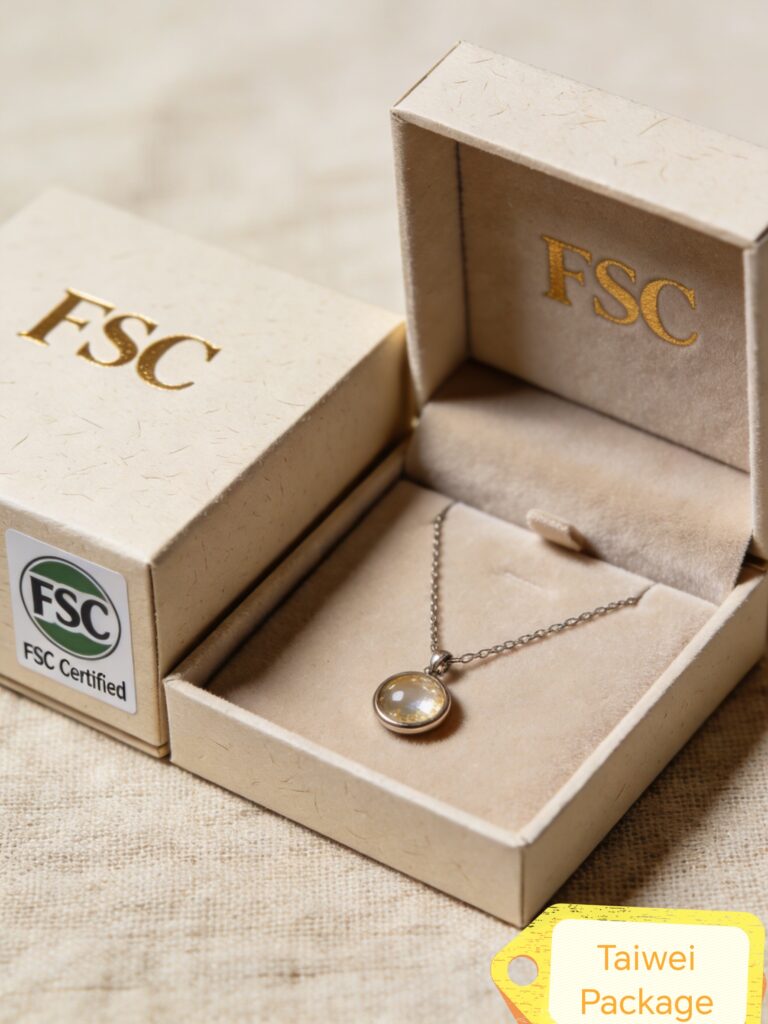
1.FSC-Certified Recycled Paper (Most Common, Suitable for All Jewelry Categories)
FSC-certified recycled paper is the mainstream choice in 2026. Made from recycled waste paper and processed through eco-friendly processes, it has passed FSC certification, reducing resource waste from the source.
Core Advantages: Moderate cost, delicate texture, can be enhanced with gilding and other processes to achieve a high-end look; recyclable and degradable, complying with PPWR regulations; lightweight and easy to transport, reducing logistics costs for brands.
Application Scenarios: Lightweight jewelry such as necklaces and earrings, suitable for mid-to-high-end brands, especially those with a simple and high-end tone.
Visual Inspiration: Choose off-white or light gray recycled paper with silver gilding for the brand logo, and add recycled cotton lining inside the box to balance protection and environmental concepts.
2.Biodegradable Corn Fiber (High-End and Niche, Highlighting Brand Tone)
Biodegradable corn fiber is an emerging material in 2026. Made from corn starch, it can be completely degraded in the natural environment after disposal, making it an ideal choice for zero-carbon packaging.
Core Advantages: Tough and waterproof, with better protective performance than ordinary recycled paper; natural and odorless, meeting food-grade standards; delicate texture, with obvious differentiation advantages.
Application Scenarios: High-value jewelry such as diamond rings and jadeite, suitable for niche high-end luxury brands, demonstrating environmental sincerity and quality.
Visual Inspiration: Retain the natural beige color of corn fiber, match it with embossed brand logos, and use light-colored biodegradable non-woven lining inside to create a natural and high-end unboxing experience.
3.Bamboo Material (Vintage Texture, Suitable for Oriental/Natural Style Brands)
Bamboo material has a short growth cycle (2-3 years to mature), is recyclable and renewable, combining environmental protection and vintage texture, which can add a unique Oriental charm to the packaging.
Core Advantages: Hard texture and strong protection, effectively preventing jewelry from collision damage; unique natural texture, which can be carved to enhance design sense; recyclable and degradable, and can be reused (e.g., as a storage box), extending the product life cycle.
Application Scenarios: Oriental-style jewelry, traditional gold jewelry, etc., suitable for brands focusing on cultural heritage and environmental protection, creating a differentiated image.
Visual Inspiration: Choose natural bamboo grain, match it with laser-engraved brand logos, use dark recycled velvet lining inside, and add metal buckles to improve practicality.
4.Recycled Leather (High-End Texture, Suitable for Light Luxury/Luxury Brands)
Recycled leather (also known as reclaimed leather) is made by crushing, processing, and reshaping waste leather and leather scraps. It reduces pollution while retaining the high-end texture of leather, making it the preferred choice for luxury jewelry packaging in 2026.
Core Advantages: Soft and shiny, little difference from natural leather; wear-resistant and waterproof, with strong protection, and can be reused; recyclable and degradable, meeting the environmental demands of luxury brands.
Application Scenarios: High-value jewelry such as high-end watches and necklaces, suitable for light luxury and luxury brands, meeting the dual needs of texture and environmental protection.
Visual Inspiration: Choose dark brown or black recycled leather, match it with gilded brand logos and metal buckles, and use recycled velvet lining inside to create a luxurious unboxing experience.
Key Tips for Customizing Eco-Friendly Jewelry Boxes in 2026
After choosing the right materials, mastering the following tips can improve brand recognition and SEO exposure, suitable for all jewelry brands:
Highlight Environmental Labels: Print FSC certification and recyclable labels, add environmental slogans, strengthen the brand image and improve keyword relevance.
Bind Brand Elements: Integrate brand logos and brand colors to ensure that the materials match the brand tone, improving recognition and content pertinence.
Emphasize Reusability: Design storage functions to guide consumers to reuse the box, align with sustainable environmental keywords, and improve SEO scores.
Conclusion: Core Trends of Eco-Friendly Smyckesförpackningar in 2026
The core of choosing materials for custom jewelry boxes in 2026 is to balance environmental protection, texture, and compliance. FSC-certified recycled paper is suitable for most brands, while corn fiber, bamboo, and recycled leather can create differentiation. Eco-friendly packaging is not a cost increase, but a long-term investment for the brand—it can meet consumer demands, respond to regulatory changes, and help your brand gain a firm foothold in the fierce market competition.
If you need to customize eco-friendly jewelry boxes that fit your brand tone, please contact us. We will recommend the most suitable eco-friendly materials and customization solutions according to your jewelry category and brand positioning, helping your brand achieve dual improvement in environmental protection and high-end quality.