
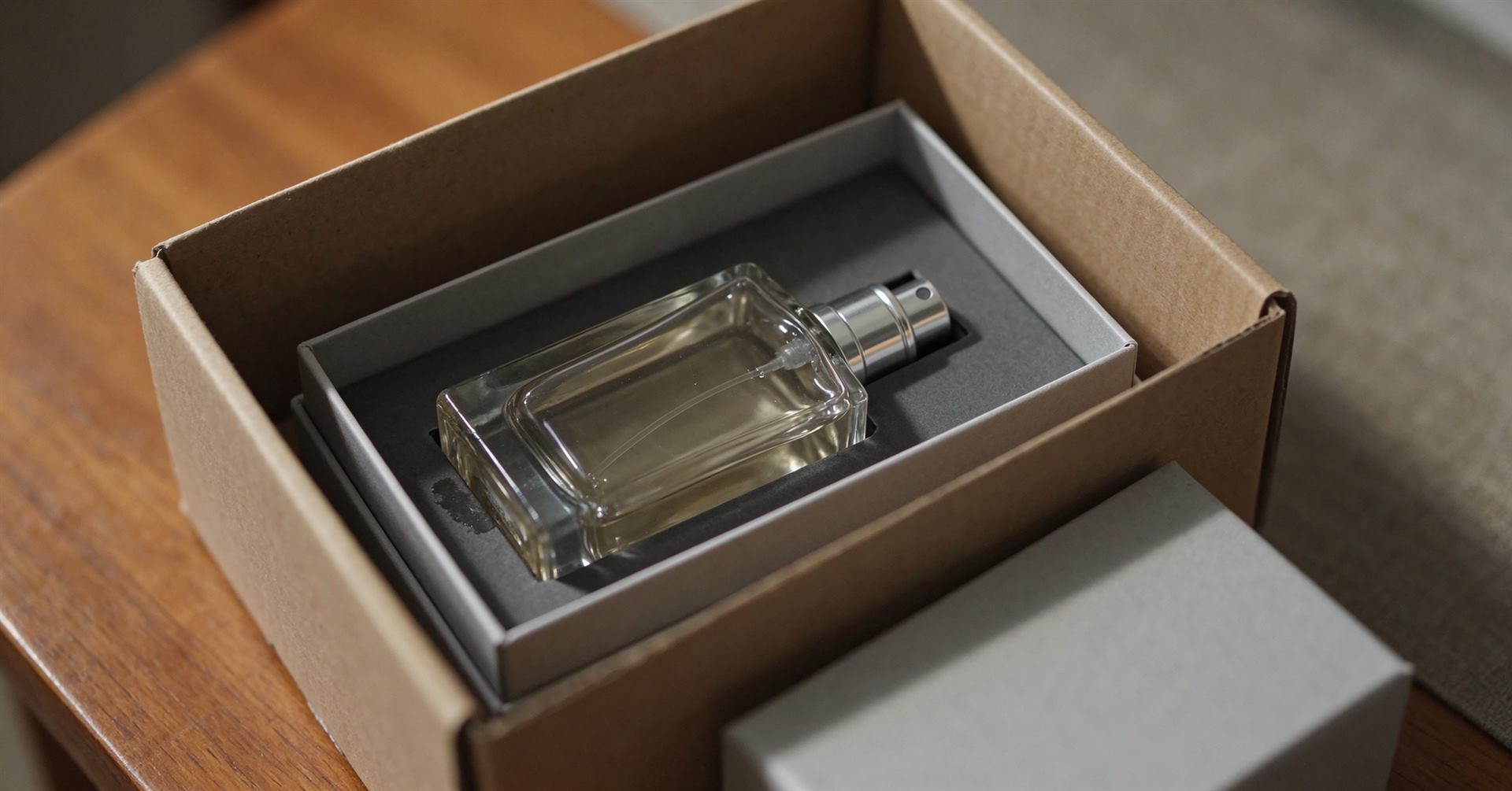
A batch of glass perfume bottles passes fill and spray checks at the factory. Days later, a customer opens an undamaged shipping carton and finds fragrance around the bottle neck and a wet patch in the gift box insert. The retained bottle from the same batch is dry. Should the quality team look at the crimp, the spray pump, or the way the bottle was packed?
Start by checking what the factory actually tested. Perfume bottle leakage during shipping can involve a bottle that loses liquid at the neck or a sprayer that discharges when the packed bottle is loaded. Fill quantity, spray function, bottle seal integrity, and shipping-pack performance each require separate evidence. Use the wet mark to pick a starting point, then compare retained bottles and packed samples to see which condition reproduces the problem.
Table of Contents
- Four checks for investigating perfume bottle leakage
- Why can a water-filled sample pass while perfume seeps?
- What should you inspect on a crimped perfume bottle?
- How do you trace perfume bottle leakage from a wet mark?
- How can you reproduce perfume bottle leakage in the shipping pack?
- What belongs in routine release and change validation?
- Frequently asked questions
- Conclusion
1.Four checks for investigating perfume bottle leakage
| Check | Question | Evidence to keep |
|---|---|---|
| Fill quantity | Did the bottle receive the specified amount? | Fill quantity or net weight, sampling time, and lot |
| Spray function | Does the pump prime, spray, and return as intended? | Functional result, pump lot, and any abnormal behavior |
| Bottle seal integrity | Does the assembled bottle lose liquid under the specified conditions? | Orientation, temperature, observation window, wet marks, and any weight or leak-test results |
| Shipping-pack performance | Does the bottle remain intact and dry in the actual shipping configuration? | Pack configuration, test conditions, opening photos, and records of movement, damage, or liquid loss |
Before comparing a dry retained bottle with a wet return, confirm the formula, glass, and pump lots. Check how long the retained bottle stood, its orientation, and whether it was ever packed. An upright sample on a factory shelf gives you a useful static comparison. The customer’s parcel may have been carried on its side or exposed to loads that sample never saw.(ISTA guidelines for selecting and using test procedures.)
2.Why can a water-filled sample pass while perfume seeps?
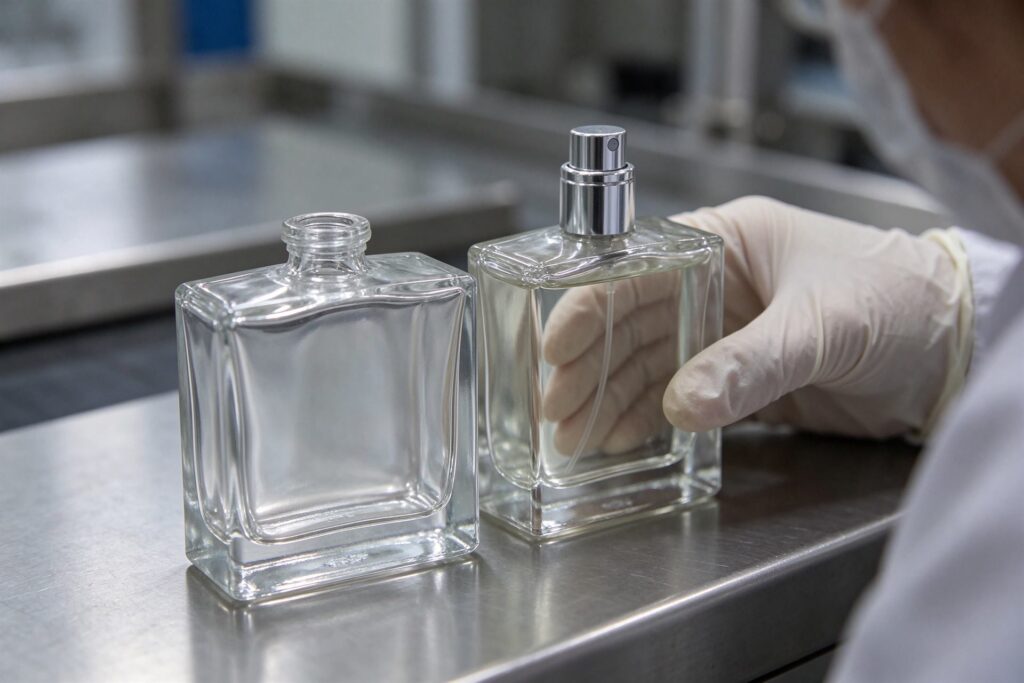
In one wetting study, the water and ethanol used had surface tensions of about 72 and 22 mN/m, respectively. An alcohol-based fragrance can wet the surfaces around a narrow opening differently from water. Whether liquid moves through that opening also depends on the contact angle, the shape and continuity of the gap, and the pressure across it. A water trial can help with setup. Use the actual fragrance formula to validate the finished assembly.( Experimental study of wetting in ethanol–water mixtures.)
Perfume bottle leakage can also appear after a delay. Contact with the formula can change a gasket’s dimensions or resilience if the material swells, softens, or loses extractable ingredients. How it responds depends on the specific material grade, the formula, and the exposure conditions. Compare filled production assemblies at the start and after a defined storage period. If a stored, unshipped sample begins to lose liquid, examine the seal and assembly before changing the carton. Use a separate sample for teardown so the original evidence stays intact.
3.What should you inspect on a crimped perfume bottle?
The aluminum ferrule holds the pump assembly on the glass neck. The gasket seals where it is compressed against the bottle’s sealing surface. A chipped rim, a tilted pump cup, a displaced gasket, or uneven ferrule formation can leave one part of that interface poorly sealed even when the front of the bottle looks normal.
- Inspect the bottle rim for residue, chips, and raised or recessed areas. Compare dimensions and flatness with the approved glass drawing.
- Check that the gasket is seated and the pump cup sits squarely before crimping. Use separate teardown samples if you need to examine gasket compression.
- Check the finished crimp height, diameter, and appearance against the approved first-off sample and supplier specifications. Record the tooling and the bottle and pump lots.
- Run the seal check with the production fragrance and link the result to the production window.
When a ferrule wrinkles or one side forms differently from the other, check tool alignment, pump seating, and neck dimensions before adjusting the machine. More force can deform the pump cup or damage the glass. For perfume bottle leakage around the neck, the useful evidence is the fit and condition of the assembled parts together with the result of the seal test. ( Perfume pump crimping and leak checks.)
4.How do you trace perfume bottle leakage from a wet mark?
At the distributor or fulfillment center, set aside traceable stock from the affected lot while quality reviews the complaint. Keep the shipper, retail box, insert, and bottle identifiers. Ask whether the mark was visible before the customer first pressed the spray head. Photograph the assembly as found and keep the returned unit for comparison.
| First visible clue | First check |
|---|---|
| Wetness around the neck or ferrule | Look for a fresh mark at the same part of the joint on a clean test sample. Review the crimp and glass dimensions if it recurs. |
| Wetness inside the overcap or at the nozzle | Check for factory spray residue and contact marks. Compare unactuated bottles stored loose and packed under the relevant load. |
| A wet insert base and a dry-looking neck | Inspect the neck, shoulder, bottle wall, and base in sequence. Liquid can run down the glass and collect below its source. |
| Complaints concentrated in one pack configuration | Recreate that pack and check bottle movement, overcap contact, and where the load is carried. |
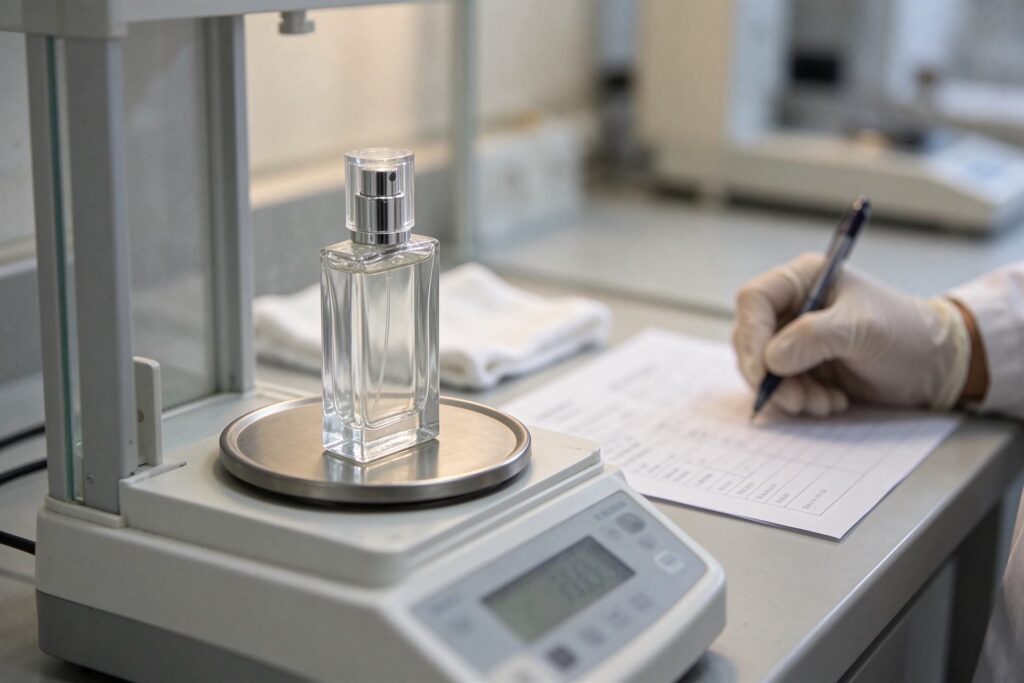
Use fresh test samples and establish a dry baseline with a lint-free cloth and a cleaning method approved for the components and decoration. Record the initial mass of the assembled bottle. Assign samples to upright, side, and inverted positions. Log the temperature, start time, and first point at which fresh liquid appears. An initial check, a 24-hour reading, and a later storage check illustrate how to record the sequence. Set the actual sample count and observation windows in the product’s validation plan.
For weight checks, use the same assembly state and avoid spraying between readings. Judge changes against scale repeatability, the behavior of control samples, and a predefined limit. Weight loss can flag a problem. A fresh mark that reappears at the same joint helps locate it.
A static visual check can miss small losses if liquid evaporates before inspection or if the opening appears only under load. When perfume bottle leakage keeps recurring despite dry samples at the bench, ask a qualified lab to evaluate a suitable method such as vacuum decay. The method detects a pressure change in a chamber around the package. Use the actual product configuration and known good and leaking controls to establish what the setup can reliably detect. The lab result can identify a failing sample. A separate examination may still be needed to locate the path.
5.How can you reproduce perfume bottle leakage in the shipping pack?
Compare three sets of samples using the same formula, bottle, pump, and overcap lots.
| Group | Setup | What the result tells you |
|---|---|---|
| A. Retained bottles | Observe unpacked bottles under defined static conditions. | Repeat wetness at the neck directs the investigation toward the seal, components, or assembly. |
| B. Production shipping pack | Use the actual retail box, insert, shipping carton, and pack count. | Reproducing perfume bottle leakage here establishes a fault under the tested packed conditions. |
| C. Shipping pack with one change | Keep the rest of the pack the same and alter one support point or the clearance above the overcap. | A repeatable improvement, together with corresponding contact evidence, supports that change. |
For parcel delivery, ISTA 3A is one procedure to assess for fit. Use the applicable procedure and distribution conditions to select the test sequence, including relevant conditioning, vibration, shock, and loads. Agree on the acceptance criteria for perfume bottle leakage and pack damage before testing. For this example, specify no new visible liquid marks on the shipper, insert, neck, or nozzle and no measured bottle mass loss beyond a validated limit. Record broken glass, a loose pump, or unintended spray actuation as well.
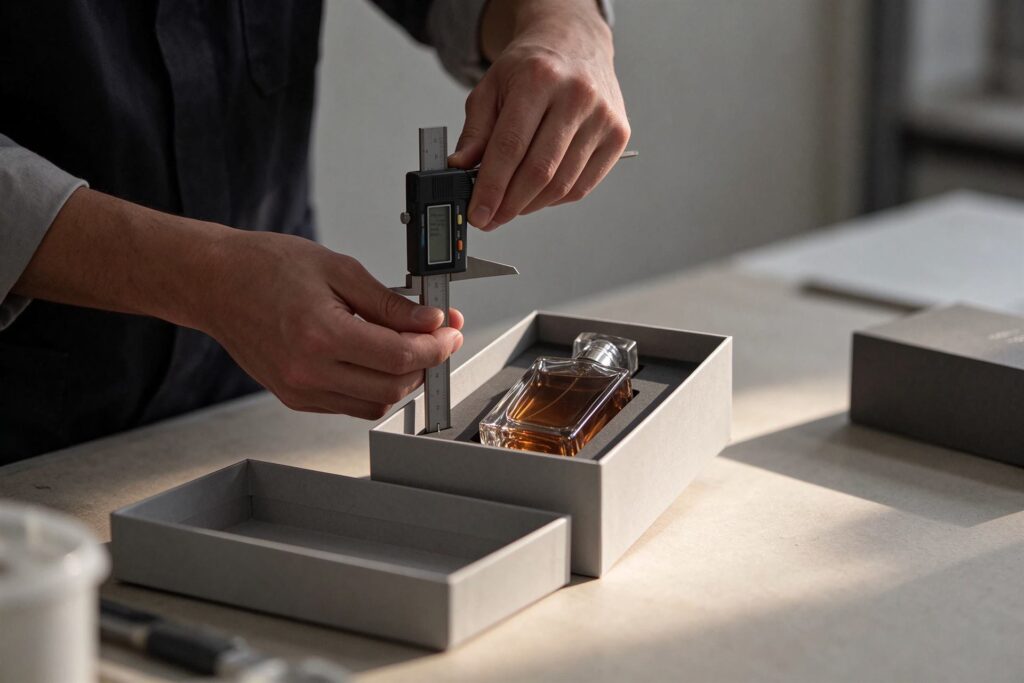
To check the insert, fit a filled bottle with its production overcap and check movement in all directions. Include a taller bottle assembly and a smaller box interior within the approved tolerances. Measure the assembled bottle height, clear height inside the closed box, and deformation under the agreed top load. Inspect for contact between the lid and overcap and evidence that the cap transferred load to the spray head. If contact occurs, change the support or clearance and repeat the test with the full shipping pack.
6.What belongs in routine release and change validation?
| Timing | What to verify |
|---|---|
| Every production lot | Link the formula, glass, and pump lots to the tooling and production window. Check the first-off and production samples. Record seal-screen orientation, observation time, and outcome. |
| First production lot or formula or gasket change | Confirm compatibility over the agreed storage period. Repeat seal validation with the actual fragrance and use a validated method if smaller leaks must be detected. |
| Glass neck, pump, or crimp-tool change | Approve a new first-off sample. Confirm fit and crimp dimensions, then recheck the assembled seal. |
| Insert, retail box, shipper, or distribution change | Verify bottle support and clearance under load. Repeat the relevant shipping test with the final pack. |
When perfume bottle leakage is found, link the corrective action and retest to the same records. If perfume bottle leakage follows one pump lot across several carton configurations, investigate that lot first. If it follows one pack configuration across otherwise comparable samples, work on that configuration. Document the conditions that reproduced the problem so the next release decision can refer to the evidence.
7.Frequently asked questions
Can a perfume bottle spray properly and still leak?
Yes. The spray check shows that the pump dispenses when actuated. The seal check examines whether the filled assembly loses liquid under defined conditions. A pump can function normally even if the joint at the neck seeps during storage.
How can you tell spray residue from a leak inside the cap?
Check whether the unit was test-sprayed and whether the customer saw the wet mark before first use. Compare dry, unactuated bottles at rest and in the production pack. Fresh liquid at the nozzle after a repeatable load, together with contact marks, gives the team a reason to investigate unintended actuation.
If a bottle passes a side test, why test the shipping pack?
A side test exposes the bottle to liquid contact in a selected orientation for a defined time. A shipping test can also expose movement inside the insert and load transferred through the lid or overcap. Together they help narrow down where perfume bottle leakage begins.
What changes for a screw-on fragrance pump?
Check thread and sealing-surface cleanliness before assembly. Apply the torque specified for the matched bottle and pump. Use separate samples to measure removal torque at the initial checkpoint, after storage, and after the applicable shipping test, since opening changes the assembly. Review torque retention alongside seal results and gasket compatibility.
8.Conclusion
When a customer reports perfume bottle leakage, start with the opening photos and trace the affected lot. If a clean retained bottle repeatedly wets at the same point, investigate the bottle, gasket, and crimp. If the issue appears in the production shipping pack and a single pack change prevents it in a repeat test, validate that change before release. If you cannot reproduce it, record the conditions still missing and test against the most credible untested condition.
For a perfume gift box or insert sample, share the production bottle or drawing, filled weight, overall height with the cap, proposed insert material, pack count, and distribution method. TW Package can use those details to review bottle support and spray-head clearance for the box sample. TW Package perfume gift box example.