
Choosing custom kraft shipping boxes starts with the product and its shipping route. Two quotes may specify different sizes or structures, so comparing unit prices alone will not show which option is a better fit for the shipment.
Two quotes arrive for custom shipping boxes. One has a lower unit price; the other is sized more closely to the product. Which is the better choice?
The box price alone does not tell the whole story. A larger outer size may affect carrier charges. Poor fit may require more void fill, while a structure that is awkward to pack can add handling time. A better comparison starts with the product and the way it will be shipped.
This guide helps you prepare a packaging brief, compare quotes, and review a sample. Here, “kraft shipping box” describes a shipping box with a kraft-paper appearance or outer facing. Confirm the actual construction, paper grades, and performance specifications with the supplier.
1. Define the job the box needs to do
“Shipping box” can mean different things. A product may ship as an individual parcel, inside a master carton, or on a pallet. These routes involve different handling and stacking conditions.
Before requesting a quote, answer these questions:
- What route will the box travel from the warehouse to the customer?
- Will it ship as an individual parcel, in a master carton, or on a pallet?
- What are the product’s weight, shape, and vulnerable areas?
- How many units will go in each box, and how will they be arranged?
- Will the customer receive this box as the outer shipping package, or will it go inside another carton?
- Does the customer, sales platform, or carrier specify packaging requirements?
These details affect the box structure, interior protection, and whether testing is appropriate. ISTA procedures serve different purposes: some are screening tools during development, while others simulate hazards associated with particular distribution environments. Select a test based on the intended shipping conditions and the result you need to evaluate, rather than treating “tested” as a universal guarantee.
2. Confirm three different sets of dimensions
A common source of confusion is that the buyer, supplier, and logistics team may be referring to different measurements.
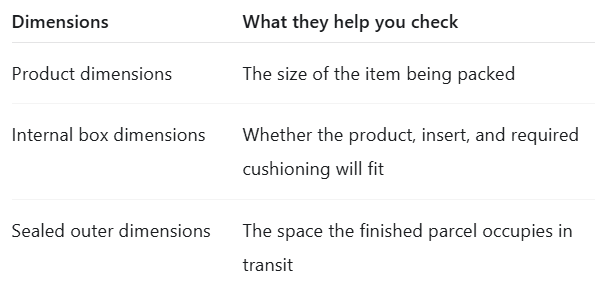
FedEx notes that dimensions shown for boxes are usually internal dimensions, while shipping charges use the package’s outside dimensions. Confirm the measurement method and current rating rules with the carrier handling your shipment.
When requesting a quote:
- Provide the product’s length, width, and height.
- Say whether those measurements are for the bare product or an already wrapped item.
- Specify the quantity per box and the product’s orientation.
- Describe any insert, divider, or individual wrapping.
- Ask the supplier to state both internal dimensions and sealed outer dimensions.
For an irregularly shaped product, include photos or a simple packing diagram. Three measurements alone may not show how the product will sit inside the box.
3. Design protection around the product
The box is only one part of the packaging system. Product stability also depends on the insert, cushioning, arrangement, and closure.
Review a sample with the actual product and ask:
- Can the product move inside the box?
- Could products rub against or strike one another?
- Does the insert keep the product in position without obstructing labels or instructions?
- Can the box be closed and sealed as intended?
For multiple items in one box, check whether they remain separated in the planned arrangement. Fragile, heavy, or irregularly shaped products may need a different protection approach. FedEx guidance recommends wrapping multiple items separately and filling voids; it also notes that loose fill offers limited protection for heavy metal items.
This does not mean every product needs more cushioning or a heavier box. Additional material takes up space, and a larger box may affect shipping cost. The goal is to check whether the complete packaging system suits the product and the shipping route.
4. Compare quotes by total cost, not unit price alone
Break each quote into the costs it may affect. A simple comparison framework is:
Total packaging-related cost = box purchase cost + inserts and void fill + shipping-cost difference + packing labor + storage + damage handling
You may not have a reliable number for every item yet. Fill in what you know and mark what needs to be confirmed.
Also check how the carrier rates the parcel. For example, UPS’s US guidance explains that dimensional weight reflects the space a package occupies and is compared with actual weight under its rating rules. The formula and divisor depend on the market and service, so do not apply one carrier’s factor globally.
Give the sealed outer dimensions to your logistics team or carrier when comparing box options. A lower box price does not necessarily mean a lower delivered cost if the finished parcel takes up significantly more space.
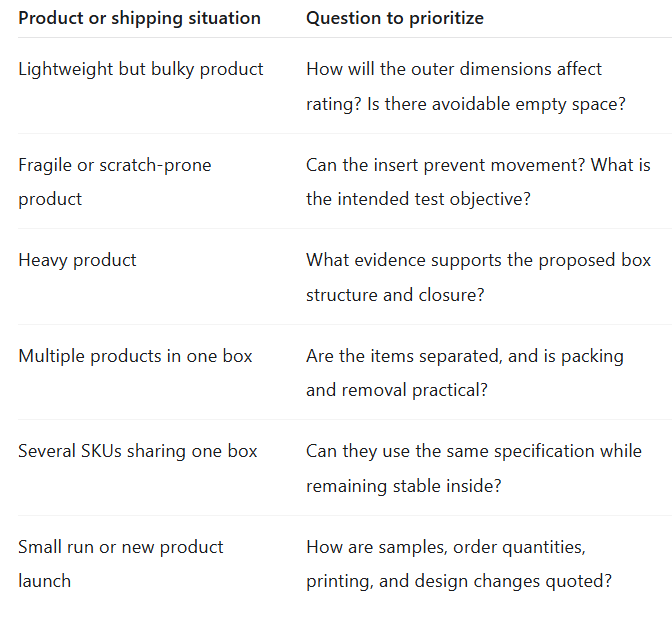
5. Match the review to the product and order
Use this table to identify what deserves the closest review. These are questions to investigate, not one-size-fits-all specifications.
If several SKUs will share a box, do more than check that each one fits. Review the product position, remaining space, and any extra fill each SKU may need. Include that material and labor in the comparison.
6. Use this checklist when reviewing a sample
Review the sample with the actual product and planned insert. Keep a record of the version so everyone knows which sample was approved.
Fit and packing
- Measure the product, insert, internal box dimensions, and sealed outer dimensions.
- Pack the planned quantity.
- Check whether any item has to be forced into place or arranged differently from the intended layout.
- Record problems with packing or closing the box.
Positioning and protection
- Gently change the box’s orientation and check for product movement or contact.
- Check whether the insert shifts, deforms, or interferes with closure.
- Note vulnerable areas and confirm how the proposed pack addresses them.
These checks help review a sample; they are not a standardized transit test. If a customer, retailer, or sales channel requires a test report, define the distribution environment first, then select the appropriate procedure. ISTA provides different procedures for different shipping and testing purposes.
Structure, closure, and labels
- Is the box easy to close and seal?
- Is there a flat area for the shipping label?
- Do folds, seams, or tape interfere with the printed information?
- Does the sample match the material and construction described in the quote?
Version control and changes
Record the dimensions, construction, material description, artwork, and approval date. If the product, box structure, material, insert, closure, or distribution route changes, review whether the previous sample or test result still applies. ISTA advises evaluating changes that may affect package performance.
7. Prepare this information before requesting a quote
A clear brief helps the supplier understand the job:
- Product name, photos, dimensions, and weight
- Fragile areas or surfaces that need protection
- Quantity per box and planned arrangement
- Shipping method, destination markets, and sales channels
- Insert, divider, or outer-packaging requirements
- Logo artwork, print files, color references, or sample designs
- Expected order quantity and timing
- Customer, platform, or carrier packaging requirements
- Requested quote details, including dimensions, construction, material description, and included components
ال Custom Brown Kraft Shipping Boxes listing is a starting point for discussing this product. Confirm the construction, material, dimensions, order terms, and sample arrangements against the requirements of your project.
أسئلة مكررة
What dimensions should I provide for custom kraft shipping boxes?
Provide the product dimensions, quantity per box, arrangement, and insert requirements. Ask the supplier to state both internal dimensions and sealed outer dimensions. For an irregular shape, include a photo or packing diagram.
Should I compare quotes by box price only?
No. Include inserts, void fill, sealed outer dimensions, packing steps, and order quantity in the comparison. Confirm shipping rates with the carrier serving your destination.
Does a thicker box always provide better shipping protection?
Not by itself. Protection depends on the product’s weight and shape, how it is positioned inside, the closure, and the distribution environment. Ask the supplier to explain the basis for the proposed construction, then review a sample with the actual product. If formal testing is required, confirm the appropriate procedure.
Can I rely on the original sample or test after changing materials?
Do not assume the result still applies. Changes to materials, structure, dimensions, inserts, or distribution may affect performance. Review the specification and assess whether additional testing is needed.
Start with the product and shipping route
Choosing custom kraft shipping boxes is more than finding the lowest unit price. The fit, internal protection, sealed outer dimensions, and quote inclusions all affect whether the box works for the intended shipment.
Prepare the product and shipping details first. Ask the supplier to document the dimensions, construction, material description, and quote inclusions. Then review a sample with the actual product. This gives your team a sounder basis for comparing protection, packing effort, and shipping cost.
Planning a custom shipping box? Share the product dimensions, quantity per box, shipping method, and expected order quantity to discuss a suitable box structure and quote.