
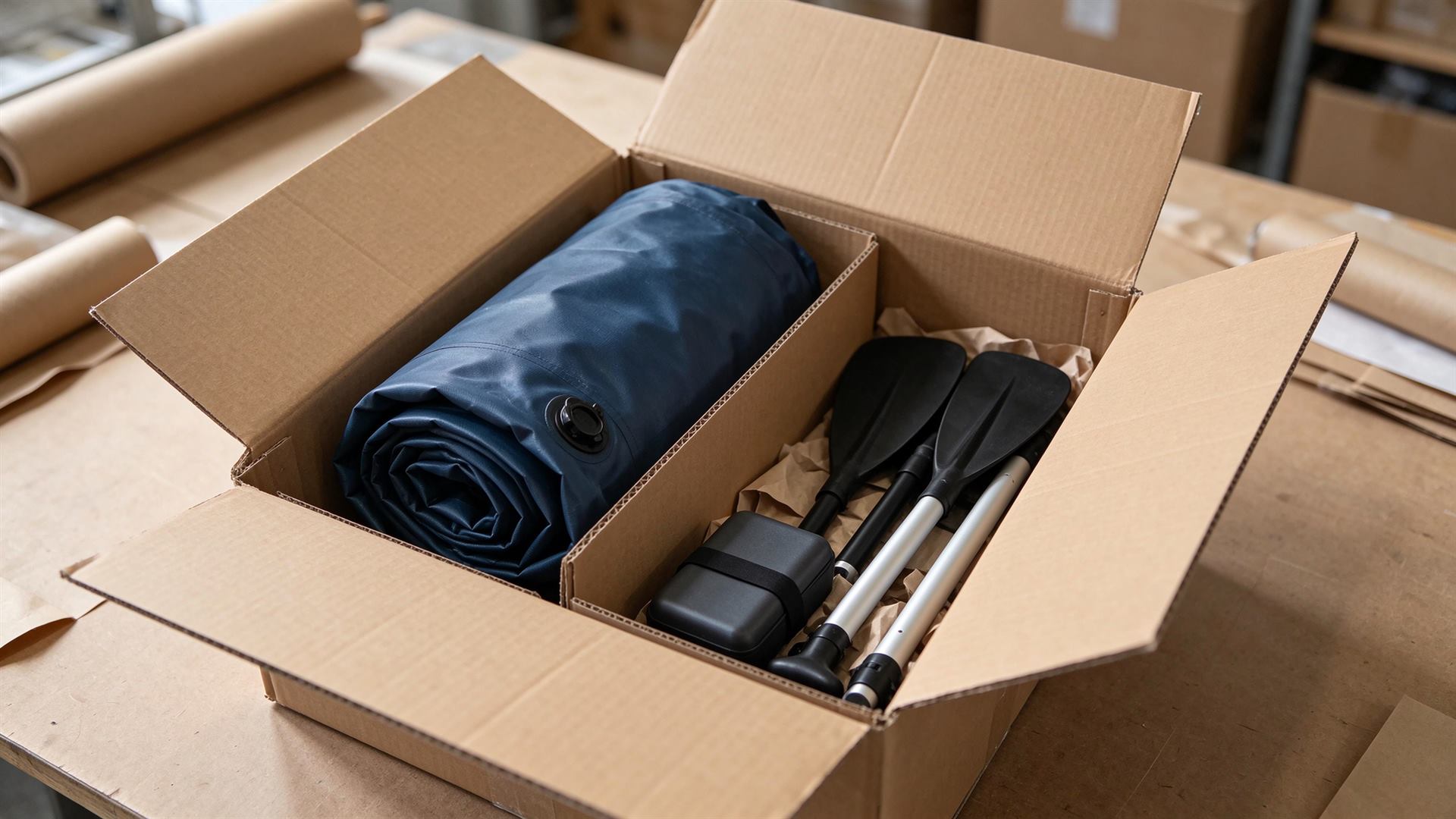
Knowing how to ship an inflatable paddle board starts with controlling what can move inside the box. Cradle the rolled board and give the pump, paddle and fin separate restraints so they cannot rub the board or press into its valve and fin box. Then compare two loaded samples: one with the pump beside the board and one with the pump in a compartment at the end. Measure, weigh and test both before choosing a carton for production.
A pump can feel snug at the packing bench and still leave a pump-shaped mark on the board after repeated impacts. A narrower box can reduce billable weight and still fit the same number of cartons on a pallet. The packing decision comes down to what each layout protects and what it costs to ship.
Table of contents
- Measure the complete kit
- Compare two carton layouts
- Protect the outer carton and its contents
- Compare shipping costs and pallet space
- Test the package and inspect it on arrival
- Apply the same checks to other bulky products
- Prepare the sample brief and check the destination market
- أسئلة مكررة
1. Measure the complete kit before you choose a carton
An inflatable paddle board kit typically includes the board, a manual pump, a sectional paddle, a removable fin, a leash and the bag. A 10 ft 6 in Decathlon inflatable stand-up paddle board (SUP) weighs about 8.4 kg on its own. Decathlon lists about 9.6 kg for the board, leash, fin and backpack together, plus 0.85 kg for the paddle and 1.2 kg for the pump. Those listed items add up to about 11.65 kg. The 92 × 40 × 30 cm figure on the product page describes the bag containing the folded board. The shipment’s gross weight and carton dimensions have to be measured after packing.( Decathlon product specifications.)
- Deflate the board, remove the detachable fin and roll the board as directed by the manufacturer. Measure the widest and thickest points of the roll. Mark the valve, fin box and any protrusions.
- Break down the paddle and measure its longest section. Note which ends could press into a wall. Measure the pump across the base and handle as well as along its length.
- Count the hose, fin, leash, tools and instructions. Decide which pieces need their own retainers and which can share a secured accessory box.
- Once the sample is sealed, measure the maximum outside dimensions, including any bulges, and weigh the complete package. Keep the board weight, kit weight and sealed gross weight on the packing sheet.
If the longest paddle section already sets the carton length, tightening the board roll may do little for that dimension. Look at the pump footprint and the unused space beside and beyond the roll before changing the way the board is rolled.
2. How to ship an inflatable paddle board with two carton layouts
Layout A: Put the pump in a side compartment
Cradle the rolled inflatable paddle board in the main compartment. Run the paddle sections parallel to it in a side bay and fit stops at both ends. Give the pump its own retainer within that bay so its base and handle cannot travel toward the board. Secure the fin and tools in a small accessory box so the entire box cannot slide toward the valve.
A side bay may make the carton wider. During the trial pack, look at how the divider is supported and where the paddle ends sit relative to the end walls. Reorient the sample gently through the permitted handling positions, then check whether the accessories have shifted. This can reveal an obvious fit problem before a formal transit test.
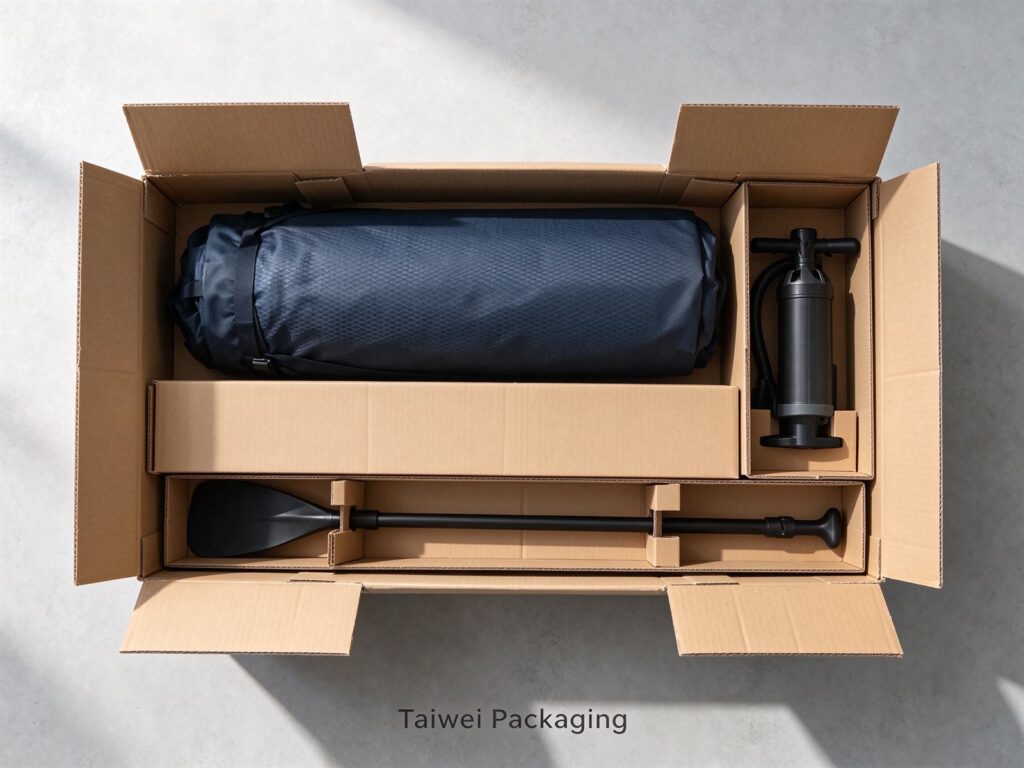
Layout B: Put the pump in an end compartment
Place the pump crosswise in a compartment at the end of the carton. Use a retainer to limit movement toward the roll and a full divider between the two. Add local cushioning where the fitted sample shows it is needed, such as around the pump base or connector. Keep the paddle sections in a narrow lengthwise channel with stops at both ends. Position the roll so the valve and fin box are out of the pump’s likely load path.
This layout may narrow the carton, but it can add length. It works best as a candidate when the paddle already sets the longest dimension and there is usable space beyond the roll. Measure the closed box to see what actually changed. In both layouts the divider separates parts, retainers limit movement, and cushioning softens impacts at specific points. A loose pocket of filler can be pushed aside if the pump or paddle keeps moving. ( FedEx packing guide.)
3. Protect the carton from moisture, bottom failure and missing parts
Keep moisture away from the board and carton
A suitable inner bag can protect a dry inflatable paddle board from incidental moisture. A pallet top cover and external wrap may help with splashes during transfers. For a used board or return, follow the manufacturer’s cleaning instructions and let the board dry fully before rolling and bagging it. At receiving, check the carton base, corners, bag opening and accessory box. A softened carton with a dry bag interior points to a different line of inquiry from a dry carton with droplets inside the bag.
Check how the carton base carries the load
Inspect a fully loaded sample. Look for concentrated pressure under the pump or accessory box, bulging bottom flaps, opening seams and corners that deform first. Assess corrugated strength, base support and closure together. For pallet shipments, keep cartons within the pallet footprint, check that upper loads are supported and use edge protection where straps bear against the carton. Check that forks can enter the pallet without contacting the boxes.
Make missing parts and reclosure easier to investigate
Secure the accessory box before closing the carton. Check its contents against a packing list. A tamper-evident seal can help document the condition of the closure when its location and identifier are photographed at dispatch. Ask receiving staff to photograph the seal and carton seams before opening and then count the parts. A changed seal alone cannot establish whether there was an inspection, a reclosure after damage or a problem with the original closure.
4. Quote the two cartons and check pallet space
When deciding how to ship an inflatable paddle board internationally, quote the packed samples with the same origin, destination, service and piece count. Use these two hypothetical packed samples below to see how a layout change can affect the quote. Both weigh 24 kg gross and are separate from the Decathlon product example.
- A, side compartment: 96 × 48 × 36 cm outside. Length plus girth is 264 cm.
- B, end compartment: 96 × 43 × 33 cm outside. Length plus girth is 248 cm.
Length plus girth is the longest side plus twice each of the other sides. Dimensional weight is the product of the three outside dimensions divided by the service’s divisor. The examples below use the greater of gross and dimensional weight before carrier rounding, minimum charges or surcharges.
| Example divisor | Layout A | Layout B |
|---|---|---|
| 6,000 | 27.65 kg | 24.00 kg |
| 5,000 | 33.18 kg | 27.24 kg |
B uses about 18% less carton volume. With a divisor of 6,000, its dimensional weight is 22.70 kg, so the 24 kg gross weight controls. With a divisor of 5,000, its dimensional weight still controls. Ask which divisor and rounding rules apply to the quoted service.
Check dimensional surcharges separately
For applicable FedEx China services, length plus girth above 266 cm is one trigger for a dimensional additional handling surcharge. The longest side, second-longest side and cubic volume are also checked. If A measures 50 cm wide after packing instead of 48 cm, with the other sides unchanged, its length plus girth becomes 268 cm. The 2026 DHL Express China guide lists a different oversize test: a longest side exceeding 100 cm or a second-longest side exceeding 80 cm. Ask the carrier or forwarder to itemize any charges that apply to your measured samples.
Count cartons per layer before booking pallet space
Consider a 120 × 100 cm pallet. Align the 96 cm carton length with the pallet’s 100 cm side. Across the 120 cm side, two A cartons use 96 cm and two B cartons use 86 cm. B leaves more room, but three B cartons would need 129 cm in that orientation. Check possible orientations, allowed stack height and stability with the loaded cartons. Give the forwarder the finished pallet footprint, total height and gross weight, stackability and permitted orientations. The carrier determines aircraft acceptance and placement under the relevant unit load device contour, weight and balance limits.
Compare total cost per carton
For each inflatable paddle board carton, ask the packaging supplier for separate costs for corrugated board, inserts, cushioning and assembly. Put those costs beside the carrier’s quotes and any applicable surcharges. If both layouts pass acceptance, B costs less overall when the shipping savings exceed any increase in packing and assembly costs. Time a trial run on the packing line so a fiddly end insert shows up in the comparison.
5. Open the test carton in a way that reveals what failed
Photograph the inflatable paddle board and accessories in position before closing each sample, along with the restraints, box faces and seams. Agree on acceptance criteria in advance, including the condition of the board, valve and fin box, and how you will check pressure retention and accessory function.
For individual parcel delivery, evaluate ISTA 3A. For mixed less-than-truckload road freight, evaluate ISTA 3B, which covers standalone standard packages as well as palletized or skidded loads. ISTA’s public overview for lighter standard 3B packages includes free-fall drops and random vibration with a top load. Tip tests, concentrated impacts and forklift handling apply under specified conditions or to particular package types. Have your lab match the procedure to the distribution route and sample configuration.
- Inspect the outside first. Photograph crushed corners, split seams, base deformation, wet patches and changes to the seal.
- Lift the lid and photograph the contents before moving them. In A, look for side scuffs, paddle-end impressions, displaced stops and a collapsed side divider. In B, look for a pump-shaped mark on the board, inward pump movement and deformation of the end divider.
- Remove and count the accessories. Assemble the paddle sections and check that the pump and hose work.
- Unroll the board and compare new marks with the positions of the packed components. Inflate it as directed by the manufacturer, then check pressure retention, valve operation and fin fit against your agreed criteria.
Suppose the carton walls are intact, but a board has a scuff in line with the paddle end and that end has pulled free of its stop. Revise the paddle restraint or side divider and retest the same area. If the box base has buckled and the entire roll has sunk, inspect the base support and carton structure first.
6. Apply the same checks to other bulky products
For each item, identify what can move, what it can damage, and which direction needs restraint or support.
Inflatable kayaks
Locate valve and hull contact points before packing the rolled hull with seats, paddles and a pump. Compare a divided carton with a separate accessory carton if the main box is crowded. If splitting the shipment, quote both pieces and use matching kit identifiers to make partial delivery easier to detect.
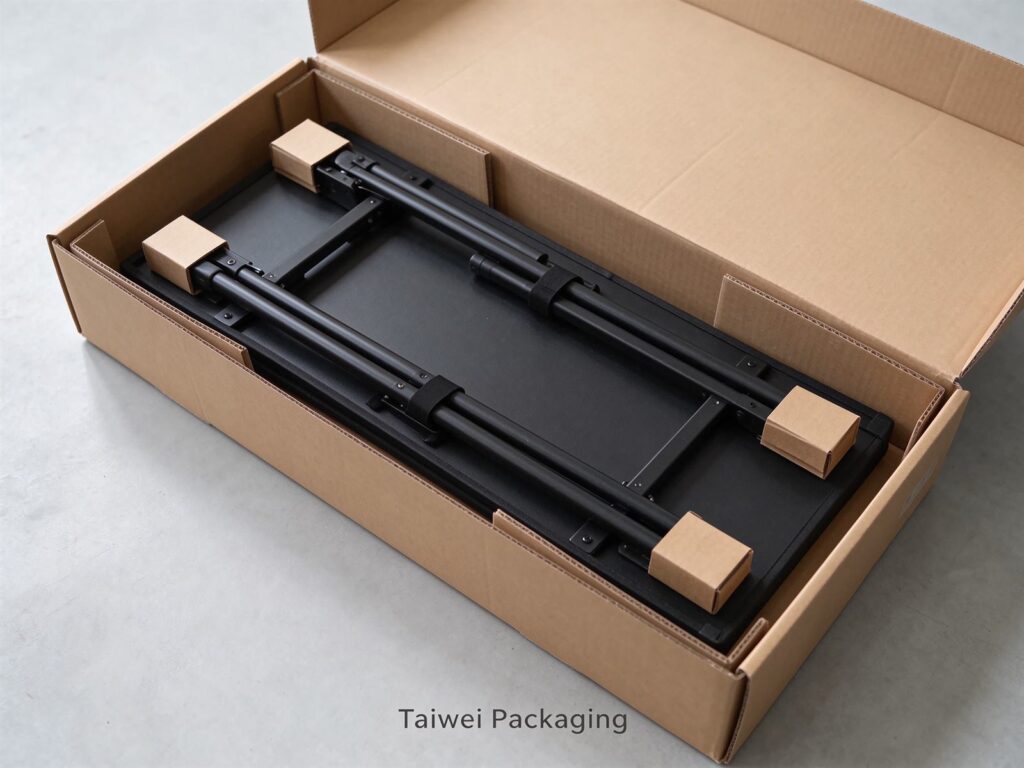
Folding camp tables
Lock the legs in their folded position, separate the feet from the tabletop and check support along long spans. After testing, inspect the area around the feet for puncture marks, look for table surface scuffs and open the legs to check the latches and stability.
Heavy fitness equipment
Trace how the weight of the frame or weight plates reaches the base, then check what controls sideways motion. Where the load requires mechanical handling, evaluate a forkable pallet, skid or crate. Confirm that restraint points hold the load, the carton stays inside the footprint and the load remains stable during handling.( DHL packing guidance by product type.)
7. Prepare the sample brief and check the destination market
Give the packaging supplier, warehouse and freight contact the same brief:
- Kit list, maximum rolled size, longest paddle section, pump dimensions and component weights.
- Photos of the valve, fin box and other points that must stay clear of direct pressure.
- Layouts A and B, sealed outside dimensions and gross weight for each, and any carton limits for the service.
- Origin, destination, mode, shipment quantity, and pallet footprint, height, weight and stacking requirements where applicable.
- Acceptance criteria, dispatch photos to retain and separate estimates for materials and packing labor.
If you sell an inflatable paddle board kit in the EU, identify the producer under the Packaging and Packaging Waste Regulation (PPWR) based on how the goods enter the market. Confirm the Member States where the packaging or packaged goods are first made available and who is responsible for registration. The PPWR generally applies from 12 August 2026.( PPWR Articles 44, 45 and 71.)
Then identify the box’s function. For grouped, transport and e-commerce packaging within Article 24’s scope, the 50% maximum empty-space ratio applies on the later of 1 January 2030 and three years after the relevant implementing acts enter into force. Space occupied by filler such as air cushions, bubble wrap and foam counts as empty space. If the sales packaging itself is used to ship the e-commerce order, check Article 24’s exemption and the relevant packaging minimization requirements. Record why protective space was retained and how it performed in testing.
8.Frequently asked questions
Should the inflatable paddle board and accessories ship in separate boxes?
Start with a compartmented single-carton sample. Test a separate accessory box if the single carton cannot protect the valve and paddle ends, or if the complete kit crosses a carrier’s size or weight threshold. Quote both boxes together and include the extra packing labor and the possibility of split delivery.
Can I fill the remaining space with air pillows?
First identify which spaces are providing clearance and which let hard parts move. Leave clearance at the valve and fin box where required, then test it under load. Use a retainer, divider or local cushioning where the pump or paddle can travel. For EU shipments, verify how the applicable empty-space rules treat filler.
Can a thicker carton make a lithium-powered pump eligible for air shipping?
Obtain the battery and equipment details from the supplier. Check whether the battery is contained in the pump, packed with it or shipped separately. Have the carrier confirm the applicable classification, packaging, marks and documents for the service and route before deciding whether the pump can go in the same carton.
Should I add a centimeter or two for extra protection?
Tie that space to a specific job. If it keeps the valve clear or gives end cushioning room to work, record it on the drawing and check it in the sample test. If it primarily makes packing easier, time the packing run and measure whether the extra space allows parts to move or triggers a carrier fee.
خاتمة
The decision about how to ship an inflatable paddle board should come from two loaded samples and the same acceptance criteria. Measure both sealed cartons, quote both on the intended route and inspect both after testing. Once a layout protects the board, valve and fin box, compare the total packed shipping cost, units per pallet and packing time before releasing the design.
If you are developing a shipping carton for an inflatable paddle board, kayak or other bulky product, send Taiwei Packaging the product dimensions, accessory photos, target carton size and intended shipping method to discuss the corrugated carton and insert layout.( Explore our corrugated boxes · Contact Taiwei Packaging.)