
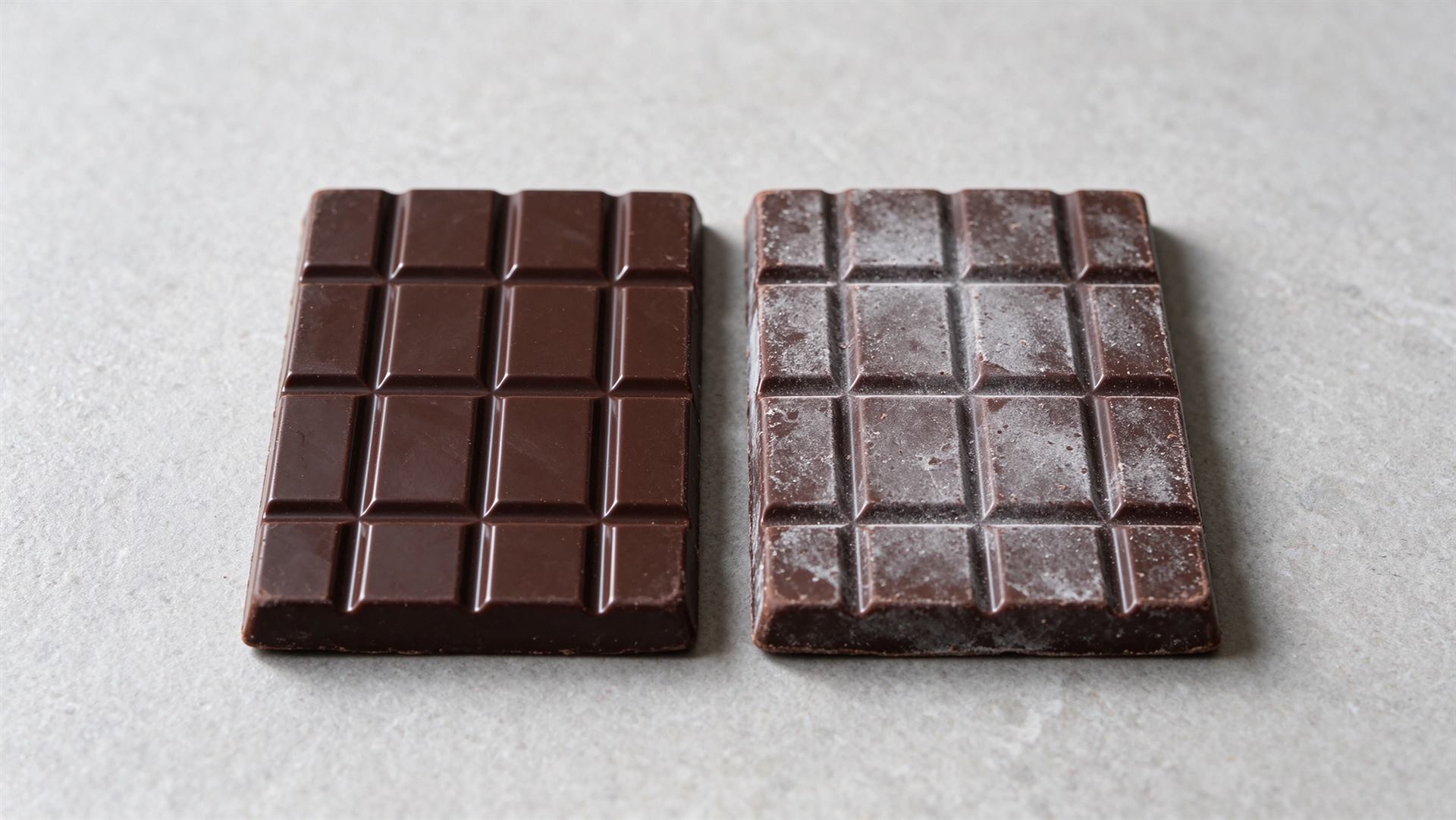
A batch of dark chocolate leaves the factory with a glossy surface. The distributor finds nothing unusual during receiving inspection. A few days later, a customer opens a bar from one store and sees a pale coating. The distributor still has some of the same batch in the warehouse, and other stores have already received their stock. Should the team check the tempering records, the shipment, or what happened at that store?
Chocolate bloom is a whitish coating that can develop on chocolate. Fat bloom involves changes in how fats move or crystallize. Sugar bloom forms when surface moisture dissolves some sugar and then evaporates, leaving sugar crystals behind. The two can look alike. A receiving team can use a few quick checks to develop a hypothesis, then compare retained samples, packaging condition, and handling records to find out where the change may have begun.(Study on identifying fat and sugar bloom · Callebaut’s chocolate bloom guide.)
Obsah
- Production: How chocolate gets its gloss
- Storage: Fat bloom vs. sugar bloom
- Transport: How temperature cycling affects chocolate bloom
- Distribution: From receiving to retail display
- At home: What to do when you suspect chocolate bloom
- Four checks to trace chocolate bloom
- Často kladené otázky
- Gift boxes for sealed chocolate
1. Production: How Chocolate Gets Its Gloss
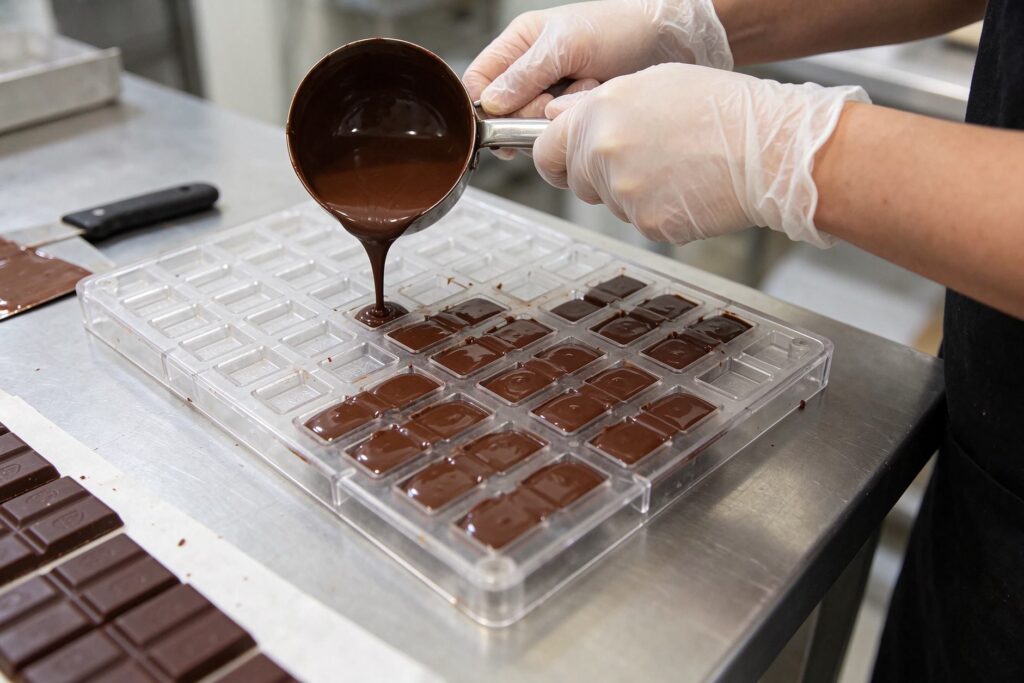
To make a molded dark chocolate bar, a manufacturer blends cocoa ingredients and sugar into a chocolate mass. Refining reduces particle size, and conching helps develop flavor and adjust how the mass flows. Before the chocolate goes into the mold, tempering prepares the cocoa butter to crystallize during cooling.
Tempering uses controlled heating and cooling to encourage suitable seed crystals. Form V is a common target for molded chocolate. It helps produce a glossy surface, a clean snap, and good release from the mold. Dark chocolate, milk chocolate, and filled products can require different settings, so the production team works from the process established for that recipe.
At release, compare the tempering and cooling records with the appearance of the finished bars. Look at gloss, mold release, and the break against the product specification. Keep a sealed sample from the same batch and packing run, and record how it is stored. A retain from the same packing run helps the factory investigate chocolate bloom at a comparable product age.
Good tempering reduces the risk of chocolate bloom. A process record shows whether tempering followed the specified settings, while crystal form requires an appropriate measurement. During storage, cocoa butter can still shift from Form V toward the more stable Form VI. Whether visible fat bloom develops also depends on fat migration and what happens at the surface.( Study on crystal form and bloom under steady and cycling temperatures. )
2. Storage: Fat Bloom vs. Sugar Bloom
How fat bloom forms
Fat bloom can develop even after the bar has set. In an under-tempered bar, the initial crystal structure can make the product more susceptible. When chocolate warms and cools again, some fat can move and recrystallize, leaving a pale film or streaks. In a filled chocolate, oils from a nut filling or another soft center can also migrate into the shell.
How sugar bloom forms
When cold chocolate meets warmer, humid air, moisture can condense on the surface. Some surface sugar dissolves in that moisture. As the water evaporates, the sugar recrystallizes and can leave a rough, pale deposit. The water may be gone by the time a customer reports chocolate bloom, so a note about visible condensation at unpacking can matter.
Screening Chocolate Bloom on a Separate Sample
Photograph the white marks before touching the bar. If marks cluster on corners, along a contact point, or in the same location on several pieces from a mold, compare them with the factory retain and check for scuffing or mold-release marks. Isolated white spots on chocolate can also be an early sign of bloom.
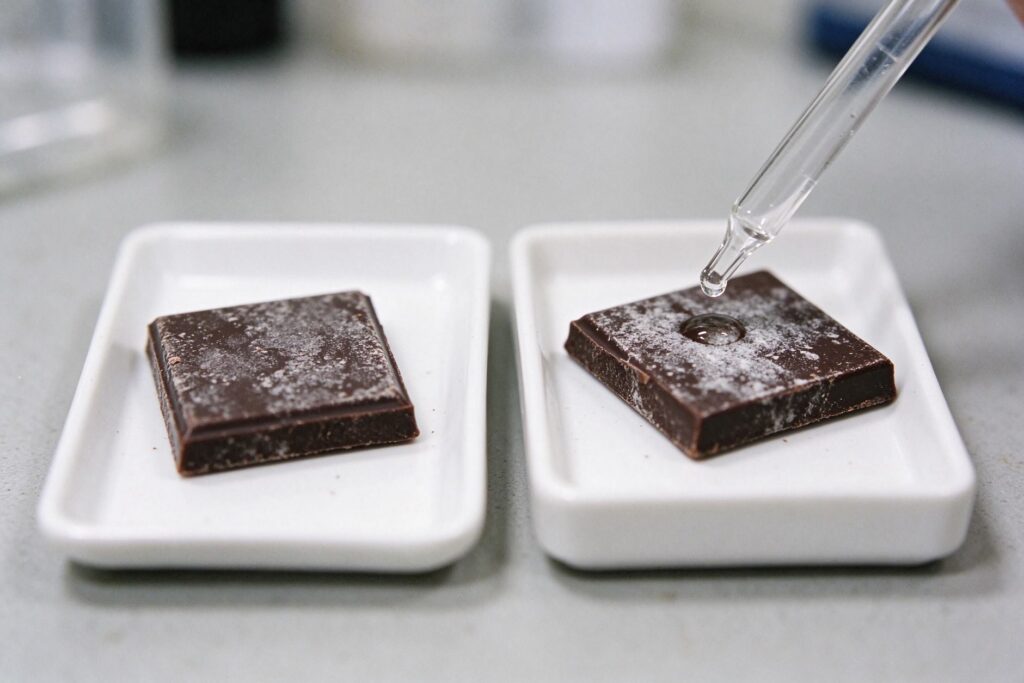
If you need to screen an affected sample, set it aside and keep another sample in its original condition.
- Feel and texture. A dry, grainy deposit is consistent with sugar bloom. A coating that softens or smears with warmth can support a fat bloom hypothesis.
- Water drop. Check whether a small area of the deposit dissolves where it contacts the water. Dissolving supports a sugar bloom hypothesis. The shape of the droplet alone tells you little.
- Local warming. On a separate quality-control sample, check whether the deposit visibly recedes where it is warmed. A coating that melts readily supports a fat bloom hypothesis.
Researchers found both sugar and fat in the same deposit in one of their tested samples. Use these checks to guide a chocolate bloom investigation, then compare the result with the batch retain and handling records.
| What you observe | What to check first |
|---|---|
| Pale streaks or a film after repeated warming and cooling | Review the temperature history and compare the bar with the batch retain and tempering record. |
| Grainy deposits after cold packs were opened in a warm room | Check for condensation, the time of opening, and the condition of the inner wrap. |
| Filled pieces affected more than solid pieces | Compare their handling history, then review the filling and shell combination. |
The temperature sensitivity of a filling can be substantial. In a model confection made with a hazelnut oil filling and a dark chocolate shell, raising storage temperature from 11 °C to 26 °C increased the oil migration rate to about 20 times its original value. That result applies to the tested combination. Use product-specific data when setting limits for other fillings and shells.
3. Transport: How Temperature Cycling Affects Chocolate Bloom
A sealed inner wrap helps limit exposure to moisture. The retail box helps protect and present the product, while the shipping carton takes much of the handling and stacking load. The transport plan controls exposure to heat and cold. Intact wrapping and cartons can arrive alongside chocolate bloom if the bars experienced temperature excursions along the way.
Sustained warmth and repeated warming and cooling can affect the bar in different ways. In a study on model chocolate made from cocoa mass, researchers compared a steady 20 °C with cycling between 20 and 29 °C and between 20 and 32 °C. The steady-temperature samples resisted visible bloom. Among the cycling samples, bloom formed faster in the group that reached 32 °C. At the higher peak, more fat was liquid, and cycling promoted migration and recrystallization. The test temperatures describe the experiment. Use the finished product specification to set transport and receiving limits. ( Controlled study on steady and cycling temperatures.)
Read the temperature trace against the shipment timeline. Check the peak temperature, time spent outside the product’s specified range, and the number of repeated excursions. Two shipments can have the same arrival temperature while one warmed repeatedly during transfers. Match the recorded peaks to loading, stops, and unloading, and note where the logger was placed. Callebaut gives 12–18 °C as an ideal storage range for pure chocolate. Follow the supplier’s requirements for the specific finished product, particularly filled chocolates.
4. Distribution: From Receiving to Retail Display
Distributors can connect a factory lot and shipment to the stores that received it. Keep the handoff records together so a complaint about chocolate bloom can be traced back through each location.
| Stage | What to check and record |
|---|---|
| Receive the shipment | Confirm the lot, arrival time, and available transport temperature records. Look for wet or crushed cartons and damaged inner wraps. Photograph and set aside affected units. If cold stock enters a warmer receiving area, log room temperature, relative humidity, the accessible surface temperature of the shipment, and any visible condensation. |
| Open and inspect | Distinguish opening the shipping carton from opening the sealed inner wrap. If the supplier calls for warming before inspection, keep the inner wrap sealed during that period. Record when the inner wrap was opened and what you observed. |
| Put stock away | Follow product-specific temperature and humidity requirements. Record where the lot is stored, avoid hot or damp locations, and ship the stock with the earliest expiry or best-before date first where applicable. |
| Deliver and display | Record which lots went to which stores and when. Check how long stock sat in the unloading area, whether it moved repeatedly between cold and warm areas, and whether display shelves were exposed to sunlight or nearby lighting heat. |
| Trace complaints | Collect the store, purchase date, lot code, first-opening photos, and packaging condition. Compare the returned units with warehouse stock and samples from other stores. |
Use Dew Point to Screen for Condensation Risk
Estimate the receiving area’s dew point from its air temperature and relative humidity. Compare it with the surface temperature of the arriving pack. When the surface is at or below the dew point of the surrounding air, moisture can condense on it. Note which packaging layer you measured. An outer-carton reading can flag a risk, while the timing of opening the inner wrap should follow the supplier’s instructions for that product.
If a customer reports chocolate bloom and samples from the warehouse and other outlets look normal, start with the affected store’s handling and display conditions. If several stores receiving the same incoming shipment have similar complaints, look upstream at their shared transport, storage, and production records.
5. At Home: What to Do When You Suspect Chocolate Bloom
Follow the storage directions on the package. Keep chocolate that is suitable for room-temperature storage in its original wrap in a dry, shaded place with a stable temperature. For products that require refrigeration, follow the label. If the supplier advises warming a cold pack before opening it, keep the inner wrap sealed until it meets those instructions. ( Callebaut’s chocolate storage FAQ.)
If you see white spots when you first open a bar, photograph the surface, seal, and lot code. Tell the seller when you received and opened it and how it was stored in between. A photo can show possible chocolate bloom, but appearance alone cannot determine food safety. If the inner wrap is damaged, there is an unusual odor, or storage conditions are uncertain, retain the pack and contact the seller.
6. Four Checks to Trace Chocolate Bloom
- Record the scope. Count units with suspected chocolate bloom and identify their cartons and stores. Photograph the outer carton, inner seal, and pattern of white marks. Mark unopened samples and keep them separate from any units used for heat or water screening.
- Compare batch retains. Compare factory retains, distributor stock, and returned units of the same recipe and packaging at a similar age. Record the storage conditions for each sample.
- Reconstruct the timeline. Link factory release, storage, loading, receiving, distribution, display, and first opening. Mark temperature peaks, repeated excursions, possible condensation, and packaging damage. If there is a gap, instrument that section on a repeat shipment.
- Choose the check that fits the evidence. Review tempering and cooling records if the retains are affected. Check opening time and receiving conditions if condensation is suspected. If the route is in question, send one sample from the same packing run and keep another in storage. Compare both at a similar age and, where possible, change one condition at a time.
The factory supplies the production record and a sealed retain. The distributor links receiving conditions to store destinations. The customer records what the chocolate looked like at first opening. Using the same lot code gives all three a way to act on the evidence.
7.Frequently Asked Questions
Why does chocolate turn white?
Chocolate bloom often appears as pale spots, streaks, or a film. Fat bloom involves fat migration or changes in fat crystals. Sugar bloom can form when moisture dissolves surface sugar and the sugar crystallizes again as the water evaporates. Both can occur together.
Can you identify the type of chocolate bloom by looking at it?
Appearance offers a starting point. A grainy deposit warrants a check for condensation and moisture. A gray-white film warrants a review of tempering, temperature changes, and any filling. A water drop or local warming on a separate sample can help guide the next check.
Why can glossy bars develop chocolate bloom days after release?
It can appear after release as the fat structure changes during storage or as the bar encounters warmth, condensation, or other handling conditions in transit or on display. A same-batch retain of similar age helps narrow down when the change occurred.
When should you open chocolate after cold transport?
Follow the supplier’s instructions for the finished product. If warming before opening is required, keep the inner wrap sealed until the product meets the specified conditions. This reduces the chance of warm, moist air reaching a cold chocolate surface and condensing on it.
8.Gift Boxes for Sealed Chocolate
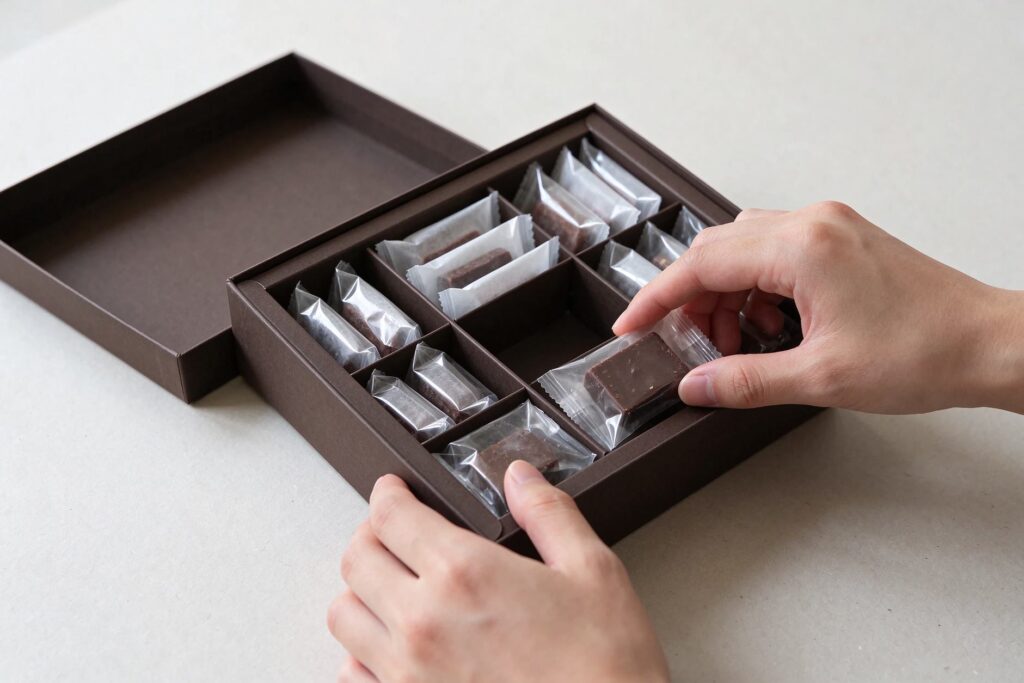
For a chocolate gift set, start with the sealed inner packs and the product’s storage and shipping requirements. Test the outer box with actual filled samples. When contacting Taiwei, share the filled pack dimensions, the number and arrangement of pieces, and whether the finished box is for store display, wholesale distribution, or parcel shipping. These details help determine fit, ease of removal, and handling protection. ( Taiwei food packaging and chocolate gift boxes.)