
Reed diffuser packaging has to do three jobs well: show the vessel on the shelf, protect it in transit, and help customers find the right refill. The carton might be opened once, but the bottle can sit on an entryway console for months. When the fragrance runs out, the customer has to decide whether to keep the vessel and use it again.During that time, the customer sees the outline of the glass, the label and the spread of the reeds every day. When the fragrance runs out, they decide whether to keep the bottle, refill it or try another scent.
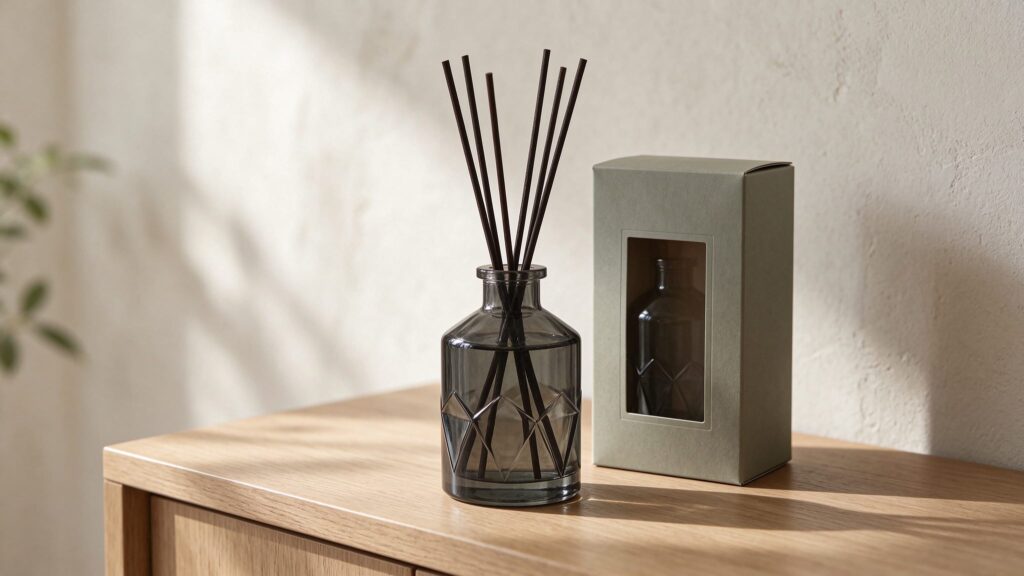
That sequence changes the packaging brief. A retail carton has to help someone recognise the scent and picture the bottle at home. A gift box has to reveal the bottle and give the recipient room to lift it. A refill pack has to make compatibility easy to check. To see how those requirements change the structure, consider one illustrative vessel with a wide base, a narrow shoulder and decorative faceted glass.
Table of contents
- Decide why customers would keep the bottle
- Reed Diffuser Packaging for Retail Display
- Gift boxes that reveal the bottle and make it easy to lift
- Refill packs customers can identify and use
- How to Check Reed Diffuser Packaging Samples
- Choose a structure and prepare for a quote
- Συχνές ερωτήσεις
1. Decide why customers would keep the bottle
Some drinks bottles borrow the proportions, glaze and ornament of ceramic vessels. After the drink is gone, the bottle can still look at home on a shelf. A reed diffuser offers a similar design opportunity. Put a sample where someone might actually use it, insert the reeds and step back. Does the silhouette still work with the reeds fanned out? Is the label what you want to see every day? If you turn the label away, which details of the vessel still hold your attention?
Diptyque sells glass diffusers and fragrance concentrates separately, so a customer can choose a vessel first and then select a fragrance. Rituals explains how to refill an existing fragrance holder and presents empty vessels as potential home accessories. The two examples suggest different design decisions. A refillable product needs a clear path back to compatible fragrance and reeds. A vessel intended to stay on display needs to look right after the carton and temporary packaging have been removed.
A brand can test those ideas separately. Put two scents from the same range side by side and see whether shoppers can tell them apart. Then show the same scent in two presentation formats and ask shoppers to describe the bottle, say where they would put it and explain what they would do when it runs out. Each question tells you something different about scent recognition, display or continued use. Price, fragrance and the occasion still matter to the purchase.
2. Reed Diffuser Packaging for Retail Display
Start where the shopper stands. In a shop with an open display sample, the actual bottle can show the glass colour, facets and scale. The carton can give more space to the scent name and volume. Put three variants in a row and check whether the shelf rail hides the scent name. Turn the cartons sideways and see whether staff can still identify the variants when restocking.
For sealed retail stock, start with a carton proof showing the actual vessel at an angle that communicates its shape. A small window is worth comparing if it reveals something the photo struggles to show, such as the colour or reflections of the glass. Check the finished carton with the bottle inside. Does the window edge buckle during handling? Can the bottle move out of view? Does a window edge or part of the insert rub the finish? For an online listing, an in-room photo can establish scale, while a separate contents photo shows what comes in the box.
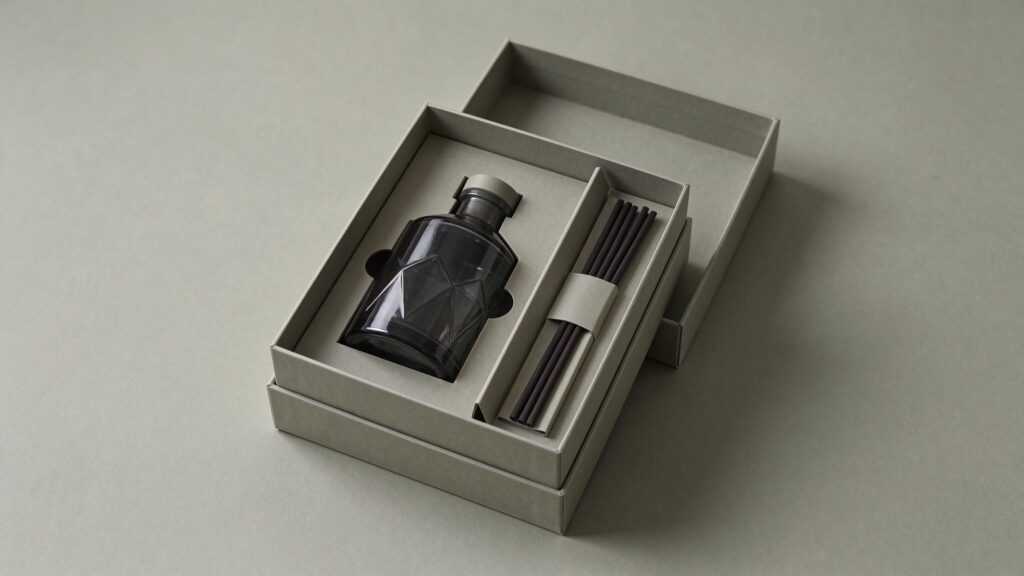
For the example bottle, start by sampling a folding carton with a fitted insert. Use the broad base and suitable areas of the body for support, with clearance around the narrow shoulder and cap. Try a side compartment if the reeds are longer than the bottle. If reed length dictates the height of the entire carton, compare a vertical layout with an angled layout for shelf proportions, removal and case packing. Review the erected sample with the filled, capped bottle and the full reed bundle inside. Taiwei custom paper folding cartons.
3. Gift boxes that reveal the bottle and make it easy to lift
When designing reed diffuser packaging for gifting, picture the recipient opening the box on a table. The most distinctive face of the bottle should be visible as soon as the lid opens. If the insert hides the glass facets, try a lower front edge or adjust the shape of the recess. If the recipient can see the bottle but can only pinch the cap to pull it out, add finger clearance where they can grip the body. A card inside the lid or in the reed compartment can keep instructions close at hand and leave the bottle in view.
Ask the supplier to quote two samples around the same contents. One can be a folding carton and paperboard insert, the other a rigid box with a fitted insert. Compare how much of the bottle each presents, how the recipient lifts it, how long the pack takes to assemble and how many units fit in the shipping case. If both support the contents and the rigid structure gives the gift a better opening sequence or display position, you can assess whether that improvement justifies the added cost and space.
A removable front panel is another way to reveal a sculptural vessel. Once you lower or remove that front edge, check which parts of the closed pack limit front-to-back movement. Taiwei’s fragrance gift box with a removable front cover illustrates the display principle. A reed diffuser version would need a sample fitted to the actual vessel and reeds. Taiwei fragrance presentation box.
4. Refill packs customers can identify and use
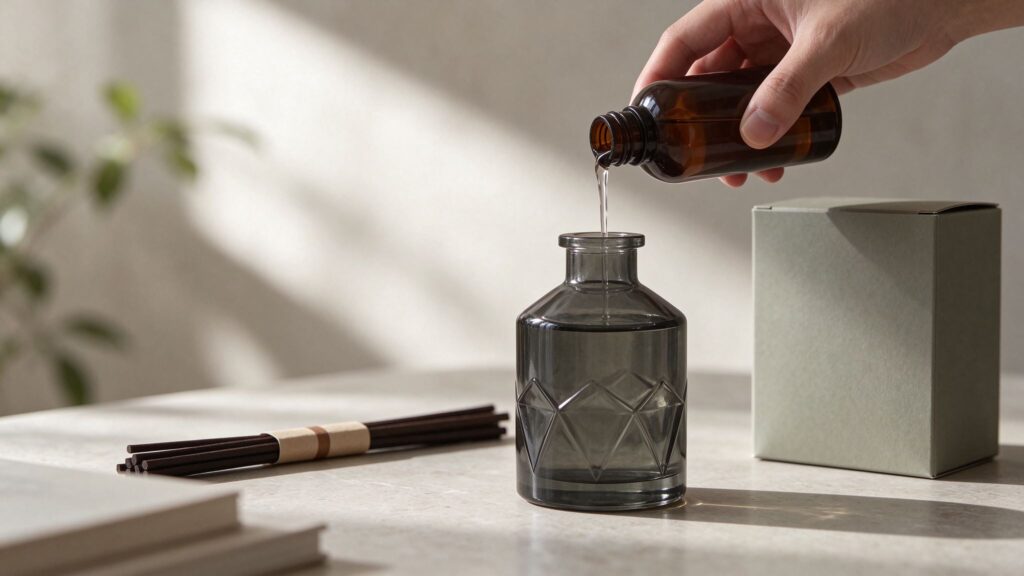
Use the original reed diffuser packaging to show customers where to buy a compatible refill and replacement reeds. An instruction card might tell them to keep the glass vessel and look for a refill and replacement reeds for that range. If the line has more than one vessel or capacity, state which refill fits which version. Make it easy to see whether the refill includes fresh reeds.
A customer picking up a refill should quickly be able to answer four questions. Is this a refill? Which scent is it? How much does it contain? Does it fit the vessel I already have? Use familiar scent colours and typography to carry the range across both packs. Put the difference between a starter set with a vessel and a fragrance refill where it can be seen on the front panel and in the online product thumbnail.
Add a refill task to the sample review. Ask someone unfamiliar with the product to follow the instructions. Watch how they open and grip the refill bottle, pour into the vessel and find the instructions for the reeds. If they hesitate or repeatedly miss the opening, examine how the instructions, vessel opening and refill closure work together. Ease of refilling is part of the experience the customer gets from keeping the original bottle.
5. How to Check Reed Diffuser Packaging Samples
Give the supplier the filled and closed bottle weight, widest body dimension, overall height including the cap, and the dimensions of the supporting surface at the base. Include the full reed length and bundle diameter. Provide front and side photos showing delicate projections, the face that needs to stay visible and the areas suitable for insert contact. Specify where the product will sell and how the finished units will be shipped.
| Check | What to do with the sample | Where to look if it fails |
|---|---|---|
| Bottle fit and removal | Pack the filled bottle and ask someone seeing the sample for the first time to take it out. | If they grip the cap, review finger clearance. If the bottle catches an edge, review the opening and contact points. |
| Bottle and reed movement | Load all components, close the box, change its orientation and open it again to inspect movement. | If the bottle rotates, review the base recess. If reeds slide into the bottle compartment, check the sleeve, partition and clearance when closed. |
| Shelf appearance | Stand scent variants beside one another under the expected lighting and at the intended shelf height. | If scent names disappear behind a rail, move the information. If the window shows an unrecognisable part of the bottle, review the opening or image angle. |
| Closure and leaks | Review the actual bottle, cap and sealing components together. Record leaks, stains and label damage under the agreed checks. | Trace any stain back to the source. Review the neck, seal and assembly, then check which parts of the carton have been affected. |
| Condition after distribution | Assemble the final retail pack, shipper and any protective material. Select a test appropriate to the intended route. | Record where breakage, leaks, insert displacement or scuffing occurred before changing the structure or case packing. |
Changing orientation is a quick way to spot loose parts during a sample review. To assess distribution performance, agree on a test and acceptance criteria that reflect how the product will ship. ISTA 3A is one option for individual parcel shipments within its scope. For direct-to-consumer orders, evaluate the retail pack together with the proposed corrugated shipper and any additional support. Keep the approved sample, key dimensions and pack-out details for comparison with the first production units.
6. Choose a structure and prepare for a quote
| Format | Where to spend the effort | What to verify before approval |
|---|---|---|
| Retail carton | Scent identification, an accurate view of the bottle and suitable support | Variants are easy to tell apart and the filled bottle can be held securely and removed easily. |
| Starter gift box | Visible bottle details, opening sequence and room to grip the vessel | The recipient can see the bottle, lift it by the body and find the reeds. |
| Refill pack | Scent, volume, compatibility and ease of pouring | Customers can identify the correct product and refill the vessel using the instructions. |
To choose reed diffuser packaging for a vessel customers may keep, start with how the bottle will look and work in the room. Then decide what the carton needs to show, what the insert needs to support and what the refill needs to explain. This gives the brand a way to compare box quotes against outcomes it can inspect on a real sample.
Send us your bottle dimensions, filled weight, reed length, sales channel and order quantity to discuss a carton, gift box or insert. If you are developing a starter set and refill together, include the contents of both packs.
Συχνές ερωτήσεις
Should I use a folding carton or a rigid box for a reed diffuser?
For a single retail diffuser, start by sampling a folding carton with a fitted insert and check support, shelf handling and removal with the filled bottle. For a gift set where the opening sequence matters, or a set that also contains a refill and accessories, sample a rigid box as well. Use the same contents in both versions and include the outer shipper when evaluating online orders.
When is a window worth adding to a diffuser box?
A window is worth sampling when shoppers cannot see an open display unit and the vessel has details that are hard to convey in a photo. Position the opening to reveal a recognisable feature. With the carton loaded, check support around the window, contact with the bottle and whether the vessel can shift out of view.
How should I arrange the bottle and reeds in a diffuser box?
A side compartment or separate sleeve can give the reeds a defined location and leave one end easy to grasp. Try the actual bundle, close the pack and check whether the reeds push against the lid or slide into the bottle compartment. Leave clearance for a customer to grip the vessel by the body.
Can I use the same box style for the starter set and the refill?
You can compare a shared structure once you have the dimensions and weight of both sets of contents, along with their protection and shelf requirements. A smaller refill may need extra support in the starter carton and occupy more space than necessary. Carry scent colours and typography across the range, and make the front panels clearly identify each format.