
The first prototype for your perfume discovery set packaging has arrived. The cover looks right, and all six spray vials sit in a neat row. Then you open the box. The insert hides part of each fragrance name. To remove a vial from the middle, you have to pull on its cap. Once two vials are on the table, it takes a moment to work out where they belong.
Fragrance can express personal style, recall a place or a memory, or set the mood for an occasion. Some people buy a discovery set to find an everyday fragrance. Others give one as a gift or want to explore a collection over several days. The cover gives them a reason to open the box. The layout helps them choose a scent, and the vial label and insert make it easy to identify, lift, and return each sample.
This guide follows a fictional six-vial set called From Dawn to Dusk. It includes 01 Morning Citrus and 06 Dusk Woods. The example shows how to turn a fragrance concept into decisions about artwork, bottle labels, and the insert. Use your actual vials, box materials, and sales channel to set dimensions and acceptance criteria.
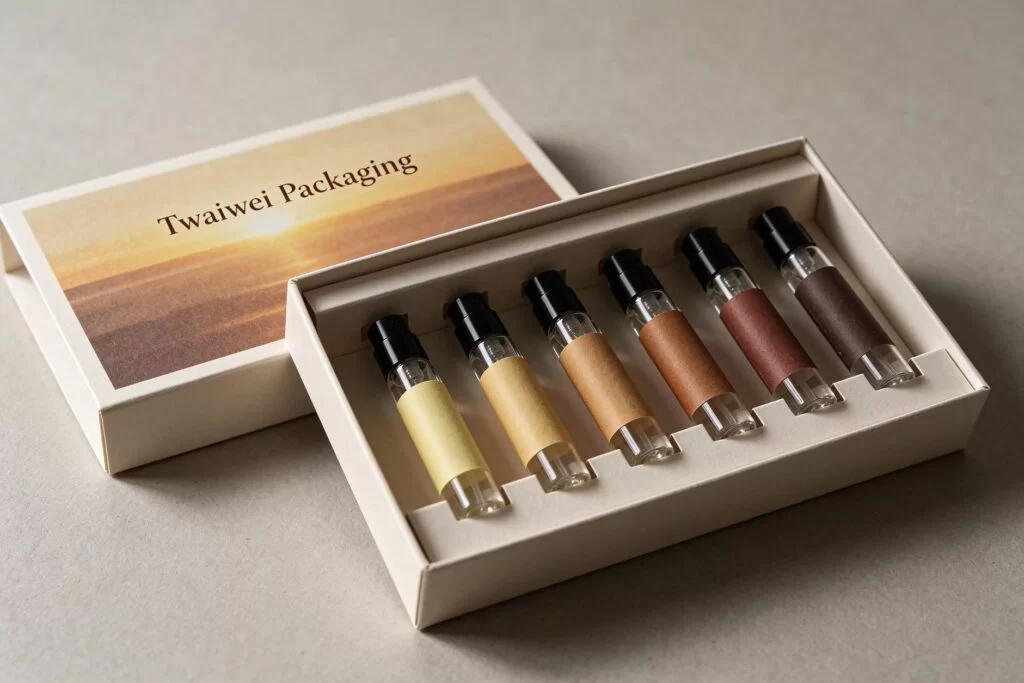
Tabla de contenido
- What Should Your Perfume Discovery Set Packaging Help Customers Discover?
- How Can the Bottle, Cover, Colors, and Artwork Tell the Same Story?
- Which Vial Dimensions Should You Measure Before Designing the Insert?
- Should the Vials Lie Flat, Stand Upright, or Sit in Layers?
- How Can You Hold Glass Vials Securely and Still Make Them Easy to Lift?
- How Will Customers Identify and Return Two Vials After Sampling?
- How Should You Review the First Perfume Discovery Set Packaging Prototype?
- Frequently Asked Questions
- Prepare Your First Prototype Brief
1.What Should Your Perfume Discovery Set Packaging Help Customers Discover?
Start with what people are most likely to do after opening the box. A set for personal discovery should be easy to use repeatedly over several days. A gift set should give someone new to the brand a clear starting point. A retail tester set should make it quick to identify a fragrance and return it to the right place. The same visual identity can serve all three, with a different emphasis inside the box.
| Main use | What the customer needs first | Design implication |
|---|---|---|
| Personal discovery | A way to identify a scent and find it again later | Keep vial IDs legible, make repeat removal easy, and consider space for brief tasting notes on a scent card |
| Gifting | A sense of what makes the collection special and where to begin | Give the cover a clear collection theme and add a short invitation inside the lid |
| In-store sampling | A quick way to match the scent being discussed to the right vial | Make slot IDs readable from a normal display angle and check that opening panels leave room for fingers |
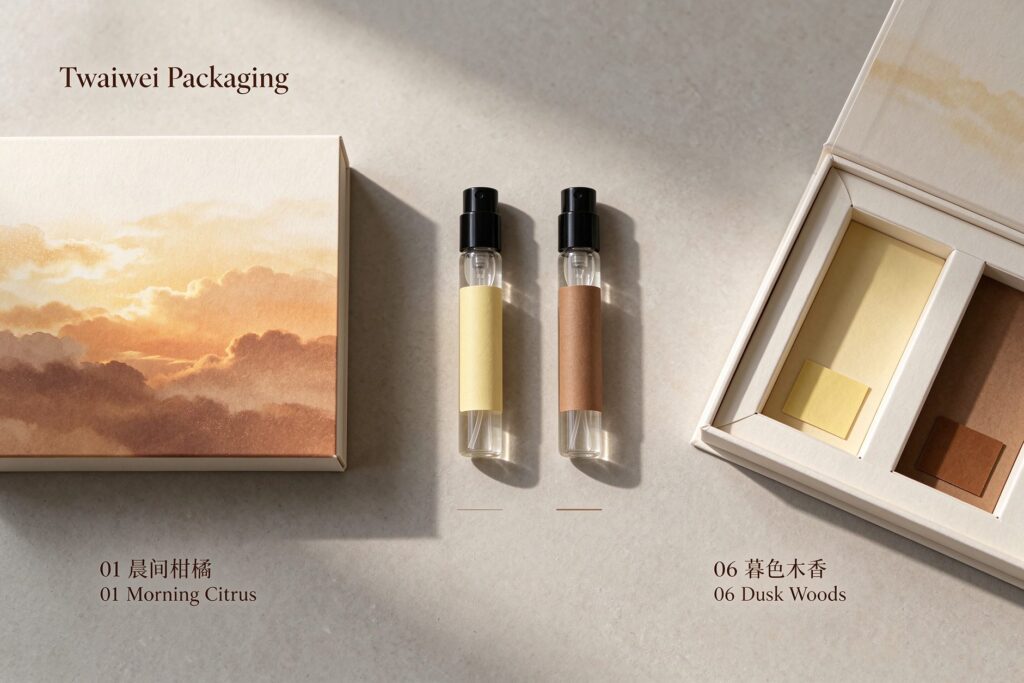
For From Dawn to Dusk, place 01 Morning Citrus at the left and 06 Dusk Woods at the right. The inside lid might say, “Start with a bright citrus, or pick the scent that feels right today.” The numbered sequence gives the collection a starting point and leaves people free to explore it in any order.
Write the design brief in one sentence before reviewing artwork or structures. For this example, it could read: “Give customers a set they can return to over several days as they discover which fragrances suit them.” That brief helps the team judge the cover, vial labels, and insert against the same use case.
2.How Can the Bottle, Cover, Colors, and Artwork Tell the Same Story?
Give each surface a job. The cover introduces the collection. The open box helps customers choose a fragrance. The vial label identifies the scent once it leaves the tray. Repeat a typeface, line style, or color palette to connect the three, and leave enough room at each scale for the information the customer needs.
Start with the vial shape and cap
Slim cylindrical bottles give the set a consistent silhouette, but their curved sides limit how much text customers can see from one angle. Print the label at actual size, apply it to an assembled vial, and look at it from the front and slightly to one side. If a long fragrance name wraps out of view, test a short name and number on the visible face. Put the full name in the lid index and account for the product information required in the markets where the set will be sold.
Cap finish also contributes to the first impression. Matching matte caps can tie six fragrances together, with label accents providing the variation. If the cap is wider than the vial body, measure the cap at its widest point. Then check the space between adjacent caps with the vials loaded. A rendering may show an even row while hiding how crowded it feels to reach into the middle.
Choose cover imagery that still works at small sizes
On the From Dawn to Dusk cover, a single illustration could move from pale morning light to warm evening tones. Place the collection name where the background gives it room to read. Give the sample count a secondary position. Inside the lid, carry over a few simple graphic details and leave space for the six names and numbers.
| Visual approach | What it can express | What to check on a proof |
|---|---|---|
| Ingredient photography | A recognizable cue such as citrus peel, wood grain, or petals | The image and fragrance copy convey the intended scent cue. The title stays legible in a small product thumbnail |
| Scene illustration | A place, time of day, or memory | Folds, seams, and opening panels preserve the parts of the illustration that carry the idea |
| Abstract texture | A feeling such as brightness, dryness, or warmth | Fine detail remains clear at its intended size. On a small vial label, the texture leaves room for the name and number |
Diptyque’s Les Essences collection offers an example of a fragrance concept expressed through both scent and drawing. For a discovery set, that approach can inform a practical artwork brief: define one idea for the collection, then choose how much of it belongs on the cover, inside the lid, and on each vial.
Use color as a cue and the vial ID as confirmation
Pale yellow can cue Morning Citrus and warm brown can cue Dusk Woods. Two woody scents can also use closely related colors when their names and numbers are easy to distinguish. Create one slot map that lists the number, name, accent color, and position for every vial. Use it to check the labels, scent card, insert artwork, and packing order.
Review the actual paper proof under the lighting people will use to open the box. Check whether a slot wall casts a shadow across small text or foil glare makes the title harder to read as the lid moves. If glare interferes with a name or number, move that information to a lower-glare area and reserve the foil for a brand mark or part of the illustration.
3.Which Vial Dimensions Should You Measure Before Designing the Insert?
Measure actual vials with the closures fitted and the labels applied. Two samples with the same fill volume can differ in body diameter, shoulder shape, cap size, or assembled length. Those details determine where the insert can support the vial, how much clearance it needs, and where a finger notch will work. If you start with bare glass samples, recheck the design once the final sprayer, cap, and label are available.
| Measurement | What it affects |
|---|---|
| Assembled length, including the cap | Usable slot length for a flat layout and lid clearance for an upright layout |
| Maximum body diameter and where it occurs | Slot width and where the insert contacts the glass. Mark any projecting shoulder or base |
| Maximum diameter of the cap or spray assembly | Spacing between vials and the room available to grip the body |
| Label height, width, and seam position | How much of the label remains visible and which edges may rub during removal |
When samples from different lots are available, use a larger measured vial to check for binding and a smaller one to check for movement. If the collection uses more than one vial shape, identify the measurements and intended slot for each type. Pair the dimension sheet with front and side photos so the packaging team can see exactly where each measurement was taken.
4.Should the Vials Lie Flat, Stand Upright, or Sit in Layers?
Compare the layouts using the same six vials. A shallow, flat layout is a sensible first prototype when customers should see all six fragrance names at once. An upright layout can suit a counter display where the bottle shape matters. A layered layout can reduce the footprint or divide the set into groups. Its prototype needs to show how people will discover and reach the lower layer.
| Layout | When it makes sense | What to check before approval |
|---|---|---|
| Flat, single layer | All six vials should be visible at once, and a shallow box suits the presentation | Can a round vial rotate until its name faces down? Can fingers reach the middle slots? |
| Upright | The set will sit open on a counter, or the full bottle profile is part of the presentation | Can a standing customer read the labels? Do the vials sit securely? Does the lid clear the caps? |
| Layered | The box footprint is limited, or the fragrances are presented in two groups | Can customers lift the upper tray steadily? Will they notice the lower tray? Does either layer press against the other when closed? |
For From Dawn to Dusk, start with six flat vials in one row. This lets customers see the sequence from 01 to 06 as soon as they open the lid. If a deep slot hides the labels, compare a lower slot edge, a different label position, and a printed name beside each vial. Change one feature at a time when you can, so the next sample shows which adjustment solved the problem.
Taiwei’s folding perfume sample gift box uses paired triangular flaps to form a display platform when opened. It offers a reference for evaluating the buyer’s viewing angle. For a six-vial layout, load the actual insert and check whether the flaps obscure an outer slot or restrict access from either side.
5.How Can You Hold Glass Vials Securely and Still Make Them Easy to Lift?
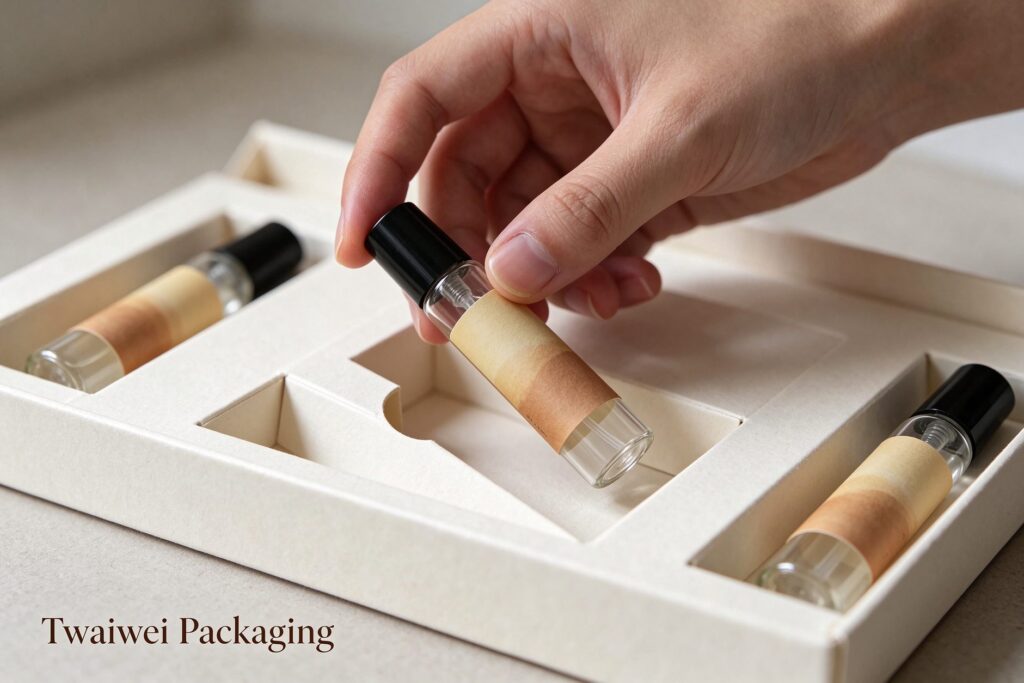
Support the vial body, limit movement along the slot, and leave an opening where fingers can grip the glass. Mark where the vial rolls or slides and where fingers need access. That gives you a starting point for the support surfaces, end stops, and finger notch. Then close the loaded box and check for contact with the caps, spray heads, and vial bodies.
| What happens in the prototype | Inspect first | What to change in the next sample |
|---|---|---|
| A vial slides lengthwise | The end stops and assembled vial length | Reduce lengthwise play and check where the stop applies pressure |
| A vial stays in its slot, but the name turns out of view | Body contact points and room for rotation | Test a different support position and place the slot ID where it stays visible |
| The cap is the only part a customer can grip | Slot depth, exposed body, and notch position | Move access toward the body. Check the middle slots as well as the outer ones |
| A cap leaves a mark inside the lid | Lid clearance, cap height, and any card inside the lid | Adjust the clearance or card position and then recheck movement in the closed box |
| Removing a vial disturbs its neighbor | The divider, hand clearance, and how the insert seats in the box | Watch whether the divider flexes, the hand touches the next vial, or the whole insert lifts. Revise the part involved |
A folded paperboard insert can support the vial on shaped panels and carry printed names beside each slot. After repeated use, look for a softened fold or a cut edge rubbing a label. A formed tray can follow the vial profile more closely. Check the grip at the tightest points, room for fingers, and whether a change in vial geometry would require new tooling. Compare both options with the actual filled set and the intended assembly process.
6.How Will Customers Identify and Return Two Vials After Sampling?
Give each fragrance an ID that stays with the vial. Print “01 Morning Citrus” on the bottle, place at least “01” beside the matching slot, and use the same number and name in the inside-lid index. This lets someone identify a vial after taking several out, even when the colors are similar or the vials have been moved around on a table.
Run a two-vial swap test
- Ask someone who did not work on the design to open the box and find 06 Dusk Woods.
- Ask them to remove two vials with similar color accents and switch their positions on the table.
- Have them identify both fragrances from the printed information and return them to their original slots.
- Record where they hesitate. Look at label visibility, the slot ID, and whether the open lid makes the index easy to read.
If they recognize both vials but cannot find the slots, move or enlarge the slot IDs. If they keep rotating a vial to find its name, review the label seam and the position of the main text. Once the layout is approved, give the artwork and assembly teams the same numbered slot map. Use that file again at final inspection.
7.How Should You Review the First Perfume Discovery Set Packaging Prototype?
Review print legibility and opening presentation first. Then load the final vial, cap, and label combination and test closing, opening, lifting, and returning each vial. Record issues by slot and action so the next prototype can be checked against them. For example, “The notch on slot 04 is too close to the cap to grip the vial body” gives the designer a specific dimension to review.
| Check | What to observe | What to record |
|---|---|---|
| View the closed box and a small e-commerce thumbnail | Brand, collection name, and set format are easy to recognize | Text lost in artwork, near a fold, or affected by glare |
| Open the box as a customer would | The intended fragrances and their IDs are visible | A photo from the user’s viewing angle showing anything hidden by a flap, slot edge, or vial |
| Load the actual vials, close the box, change its orientation, and gently shake it | Vials remain in their positions during this handling check, with no unexpected contact marks | The affected slot and whether the mark is on the vial body, label, or cap |
| Remove and return each vial | The body is easy to grip, adjacent vials stay seated, and labels do not catch | The difference between center and edge slots, plus any wear after repeated use |
| Review the full pack for e-commerce delivery | The gift box stays in position inside its shipper and the cushioning suits the delivery conditions | The shipper, cushioning, and packed configuration used for the agreed shipping validation |
Keep the approved sample with the matching dieline, label artwork, vial specification, and assembly list. Give them a shared revision number. If the cap, paperboard, or contents change, repeat the affected checks. For example, adding a scent card inside the lid changes the space available above the vials and calls for another closure check.
8.Frequently Asked Questions
Can two 2 mL perfume vials share the same insert?
They may be able to share an insert if their external dimensions and contact points are compatible. Compare the assembled length, maximum diameter, shoulder, and cap shape. Load the two designs together. Use the smaller vial to check for movement and the larger one to check for binding, cap contact, and label rub.
What if the full fragrance name is too long for the vial label?
Use a readable number and a recognizable short name for identification, then give the full name and a short scent description in the lid index. Account for required product information before finalizing the label. Print it at actual size, apply it to the vial, and read it from the normal opening distance with the vial seated in its slot.
Does a six-scent set need six different colors?
A shared base color with distinct names, numbers, and small color accents can work well. If two accents are similar, run the swap test with those vials. The result shows whether people can reliably identify and return both samples using the printed information.
Can a paperboard insert hold glass perfume vials?
A folded paperboard insert is a reasonable candidate when its panels support the vial body and its ends limit sliding. Check whether the edges rub the label, whether repeated handling changes the shape, and whether the lid clears the loaded vials. For e-commerce delivery, assess the insert inside the complete shipping pack.
What if a wider finger notch makes the vial loose?
Check which support surface was lost when the notch widened. If it removed part of a sidewall, try moving the notch, retaining a support edge, or exposing slightly more of the vial body. Repeat the removal and closed-box checks on the same sample to confirm that both actions work.
9.Prepare Your First Prototype Brief
Put the vial details, fragrance list, and visual requirements into one brief. The packaging team can use it to check slot fit, opening visibility, and finger clearance while the cover artwork is still being refined.
- Provide the number of vials per box, assembled vial dimensions, and physical samples or clear front and side photos.
- List the fragrance names, numbers, intended order, and label position on each vial.
- Explain whether the set is for personal discovery, gifting, or in-store sampling, and whether it will ship directly to customers.
- Share the brand colors, typography, cover concept, and paper or finishes you want to compare.
- Include the target order quantity and the items you want to confirm in the first prototype.
If you are developing a multi-vial fragrance set, share this brief and your vial samples to discuss a box style, insert, and first prototype. Contact the Taiwei packaging team.