
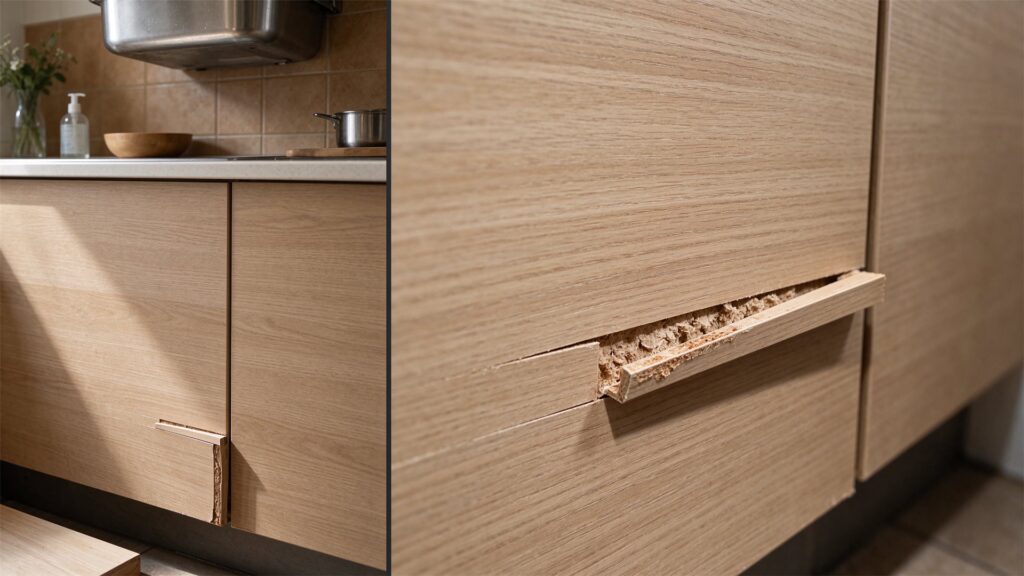
Imagine two cabinet doors in the same kitchen. The door farthest from the sink still has a smooth edge. On the door below the sink, the edge band has lifted at a lower corner, and the board underneath has swollen. Before choosing a repair, check where the water may have entered and which part changed first: the glue joint, the edge band, or the board beneath it.
Moisture plays a different role at each stage of that door’s life. A factory keeps PUR hot melt adhesive dry so it can flow properly when heated. After the edge band is pressed into place, moisture helps the adhesive cure. Once the cabinet is installed, splashes, condensation, and leaks test the whole joint. Following the adhesive from the factory to the kitchen explains what to check at each stage.
Table des matières
- Production — why the factory removes moisture
- Storage — what changes once the cartridge is opened
- Transport — what to inspect when the shipment arrives
- Application — seconds on the line, days after bonding
- Environmental considerations — exposure, emissions, and repair
- Cabinet care — what to do about water, steam, and lifting edges
- Questions fréquemment posées
- From cabinet edges to folding carton seams
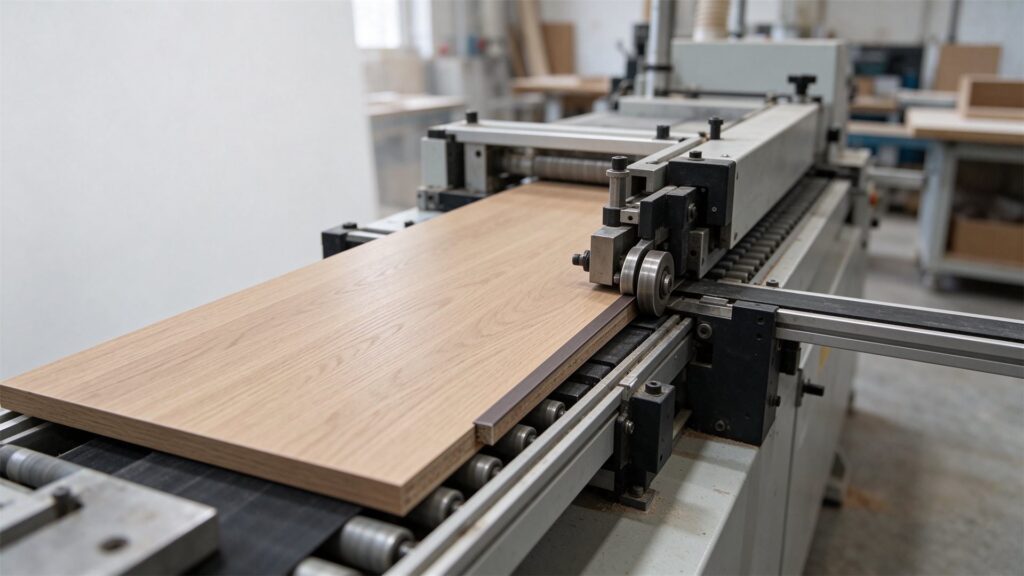
1.Production — How a moisture-curing adhesive is made, and why the factory removes moisture
Ce reactive PUR hot melt adhesive (a polyurethane system) contains a prepolymer.Its molecular chains are already partly formed, and their ends retain groups that can react later. The factory needs to preserve those reactive groups through filling, storage, and delivery so they can do their job in the glue line.
In one published manufacturing example, the producer dries polyols and other ingredients under vacuum before adding a diisocyanate. The resulting prepolymer is placed in a container with dry nitrogen in the space above it. Drying the ingredients and protecting the filled container both limit the adhesive’s contact with moisture before use.
Once the adhesive has been spread between a board edge and an edge band, moisture from the air or the materials can diffuse into the bond line. It reacts with the prepolymer, linking the chains into a crosslinked structure. If the same reaction starts inside a damaged or poorly sealed cartridge, it can change how the adhesive flows and spreads on the machine. In the assembled joint, crosslinking develops the properties of the cured bond.
2.Storage — What changes once the reactive PUR hot melt cartridge is opened
Picture two cartridges from the same delivery. One is still sealed. The other was put on the machine yesterday and has some adhesive left. Both show the same best-before date. For the sealed cartridge, check the lot, the condition of the packaging, and how it was stored. For the opened cartridge, also check when it was opened, how the remainder was handled, and what the adhesive and equipment suppliers say about reuse.
Jowat’s technical data sheet for its PUR hot melt adhesive, Jowatherm PUR 607.40/41, specifies cool, dry storage at 15–25°C (59–77°F) in properly closed original containers. The best-before date is on the container label. A shop running short batches in several colors can use its own production records to select a pack size. Check how much adhesive a shift actually uses, how much remains at a changeover, and how much time and cleaning material the changeover takes. A larger pack’s lower price per kilogram may buy little if part of it routinely goes unused.
3.Transport — What to inspect when the PUR hot melt adhesive shipment arrives
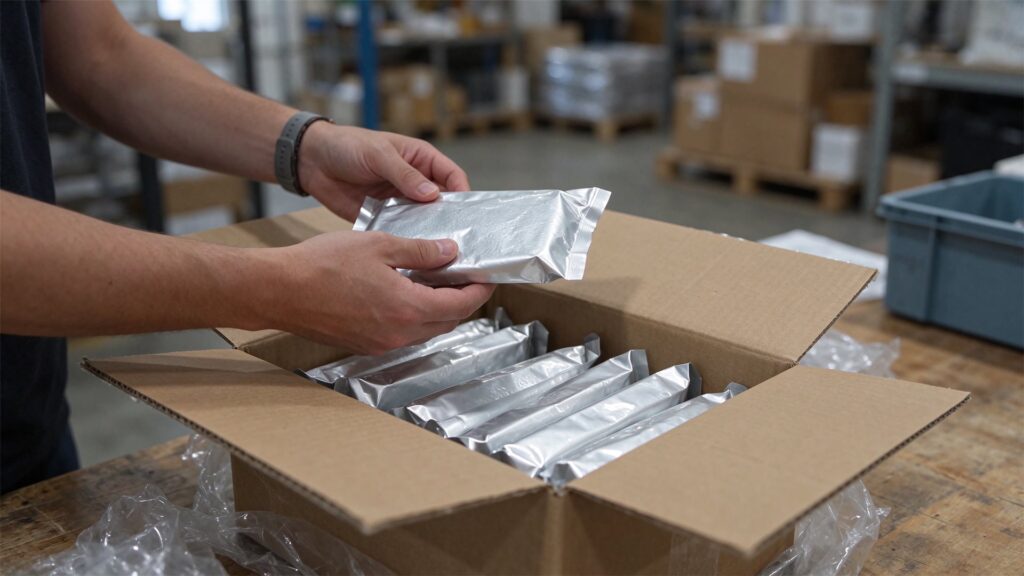
The shipping carton shows whether a case has been crushed or soaked. The cartridge or inner pouch provides the moisture barrier around the PUR hot melt adhesive. At receiving, check its seal and look for punctures or other damage. Match the product grade, lot number, and date to the delivery paperwork.
If one pouch has a cut, photograph the damage and the label, set the affected units aside, and ask the supplier how to assess them. If a shipment was delayed in unusually hot conditions, record the temperature and duration where available. Those details give the supplier a basis for deciding whether the lot needs further checks and give the production team a record to consult if dispensing problems appear later.
Use the technical data sheet (TDS) to check the grade’s storage conditions. Use the safety data sheet (SDS) and the supplier’s shipping information to check transport requirements for the package size and mode of transport.
4.Application — seconds on the line, days after bonding
The first few seconds determine how well the adhesive wets both surfaces
Le PUR hot melt adhesive starts cooling as soon as it is applied to the board edge. The pressure rollers need to bring the edge band into contact while the adhesive can still spread and wet its back. A cold panel can draw heat out of the glue line quickly, even when the machine display shows the usual melt temperature.
If the first door on a winter morning lifts at the edge, compare it with a door made once the line is running steadily. Measure the board-edge temperature and the elapsed time from glue application to the first roller that presses the band firmly into place. On a trial piece, check how much adhesive transferred to the back of the band. If most of it stayed on the board, check for early cooling, uneven pressure, and changes to the band’s surface or primer. That gives you several specific conditions to test, one at a time.
After pressing, the glue line keeps developing strength
As the adhesive cools, it develops enough initial strength to hold the edge band in place. Moisture curing continues afterward. For Jowatherm PUR 607.40/41, Jowat reports a typical edge banding open time of about 8 ± 2 seconds at 140°C (284°F) under its test method, and a reaction time of about 4–7 days depending on ambient conditions. The open time helps the line team plan when the surfaces need to meet. The reaction time helps the quality team plan when to assess cured performance.
At the end of the line, check band alignment, glue-line continuity, corners, and lifting after trimming. For a kitchen project, assess heat or moisture resistance on a finished door after the agreed cure conditions have been met. Include the lower edge and corners. A straight test strip can help compare bonds, while a complete door shows what happens where the band ends, the surfaces meet, and the board core is most exposed if a gap develops.
The Kitchen Cabinet Manufacturers Association, for example, includes an edge exposure test using a standardized detergent solution in its cabinet performance program. When reviewing a supplier’s report, ask whether the test used the adhesive alone, an edge-banded strip, or the actual door construction.
5.Environmental considerations — exposure, emissions, and repair
On the shop floor, check what workers handle during heating and cleaning
Some reactive PUR grades are formulated with lower levels of free diisocyanate monomers. Ask the supplier for documentation for the exact grade being purchased. In the EU, REACH Annex XVII, Entry 74 sets a training condition for industrial and professional use where the concentration of diisocyanates, individually or combined, is 0.1% by weight or higher. That threshold helps buyers interpret a formulation claim under the restriction. An assessment of actual workplace exposure also needs to consider the equipment, ventilation, and how operators load, change, and clean the adhesive system.
In the home, check what the emissions report actually tested
A cabinet door contains a board core, a decorative surface, and adhesive, and may include coatings. When a supplier describes the door as low-emitting, start with the sample name on the report. Check which substances were measured, how the test was run, and when the measurements were taken. A report for the adhesive and a report for an assembled door answer different questions.
For example, the California Department of Public Health’s chamber method measures volatile organic chemical emissions from indoor sources. The US EPA’s TSCA Title VI requirements address formaldehyde emissions from specified composite wood products and apply to finished goods containing those regulated materials. Match the report’s scope to the claim being made about the door you intend to buy.
Over the door’s service life, count waste, rework, and replacement
A cabinet manufacturer comparing two edge-banding specifications can use a common basis, such as every 1,000 doors delivered to the same acceptance standard. Record adhesive used, leftover material discarded after opening, cleaning supplies, equipment electricity, and reworked doors. After installation, track how many edge-related service calls are resolved with a local repair and how many require a replacement door. Those records help establish whether better durability is saving material in practice.
The cabinet design also determines how much must be replaced. If a door below the sink is damaged and a matching spare with the correct hinge locations is available, the repair may be limited to that one door. A full environmental comparison would also account for the materials, manufacturing, transport, use, and end-of-life stages.
6. Cabinet care — what to do about water, steam, and lifting edges
| What you notice | What to check first |
|---|---|
| Water beads along the cabinet door below the sink after washing dishes | Dry the lower edge, corners, and seams with a soft cloth. If the same spot repeatedly gets wet, check whether water runs down from the countertop or whether a pipe connection inside the cabinet is leaking. IKEA kitchen cleaning and care guide |
| Condensation repeatedly appears on the door next to the dishwasher | Note where it forms and which cycle was running. Check the appliance’s instructions for door opening, drying, and installation. The installer can use those details to trace the steam path and check any moisture protection specified for that model. Miele dishwasher operating instructions |
| The seam stays wet after grease is wiped away | Follow the door finish’s care instructions. Use a well-wrung soft cloth and wipe the seam dry afterward. For the finishes covered in its guide, EGGER advises against steam cleaning. EGGER cleaning and care instructions for surfaces and edge banding |
If the cabinet edge banding adhesive fails and an edge lifts, look at the shape of the board underneath. When a short section of banding has lifted and the board is still flat, photograph the spot and ask the cabinet supplier whether a local repair is possible. If the core beside the opening has swollen or softened, address any ongoing water source and have the board assessed for replacement. If the whole door has dropped and the gap between doors is slanted while the banding remains firmly attached, start by checking the hinges and their fixings.
For a service request, take one photo of the whole door and a close-up of the affected edge. Include the nearby sink or appliance in the wider photo so the technician can see where the damage sits in relation to potential sources of water or steam.
7.Frequently asked questions
Should I dampen the board edge before applying moisture-curing PUR adhesive?
Follow the surface preparation instructions for this moisture-curing adhesive. For 607.40/41, Jowat calls for dry bonding surfaces free of dust, oil, and grease. Keep the mating surfaces clean so the adhesive can wet them during pressing. Moisture from the air or the materials can then participate in curing.
Do cabinet doors have to wait 4–7 days before they can be packed and shipped?
The 4–7 days is the typical reaction time for the example grade. To set a packing time, verify that the bond at that point can withstand handling, wrapping, stacking, and the planned transport conditions. Check final performance once the agreed cure conditions have been met.
What should a workshop check before switching its edge bander to reactive PUR?
Confirm compatibility with the machine and adhesive suppliers. Ask about the melt unit, the sealed adhesive feed, and the procedures for shutdown and cleaning. For the trial, use production board, banding, and primer. Keep samples from the first run, steady production, and the restart after a stop so you can compare how the bond behaves across a normal shift.
8.From cabinet edges to folding carton seams
The same sampling question comes up in cabinet making and carton production: which two surfaces actually meet at the joint? Open the side seam of a folding carton sample and check whether the adhesive meets bare paperboard, a printed area, or a laminated finish. If the production carton will use a different finish or be erected on a high-speed packing line, sample the final board and finish and check the seam as the carton is opened on that line.Read Taiwei’s folding carton packaging guide
If you’re developing a custom folding carton, share the box style, dimensions, board, finish, and how the carton will be erected and filled. Mark the glued seam on the dieline so it can be reviewed during sampling.Contact Taiwei to discuss your folding carton sample.