
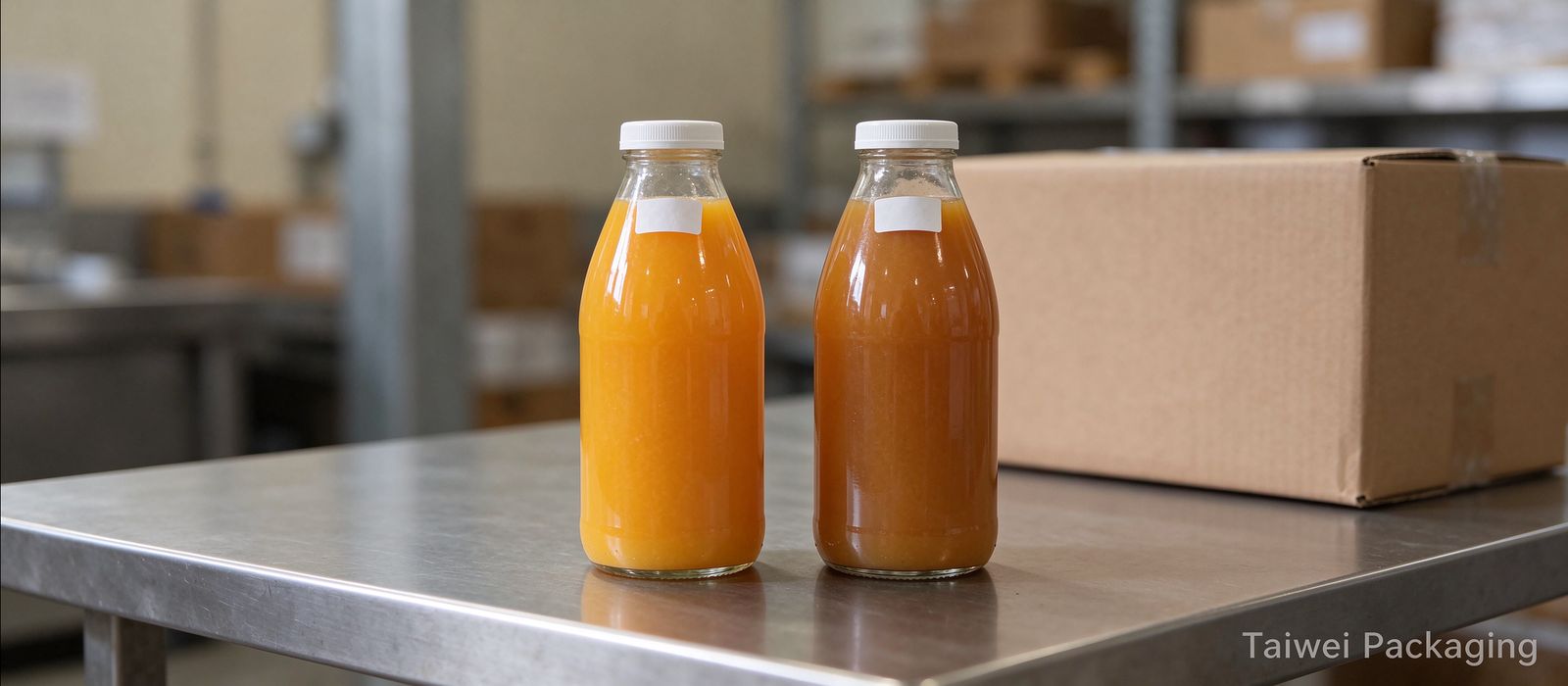
A shipment of refrigerated, pasteurized orange juice passes its color check before dispatch. At the distributor’s receiving dock, several bottles are noticeably darker than the rest. The retained samples still look normal and the caps appear intact. Should the quality team start with the filling line or the cold chain?
Start by mapping the darker bottles to their cases, pallets, and filling times. Then compare them with retained samples whose storage history you can verify. A pattern tied to one filling window points you toward production records. A pattern that crosses filling windows but clusters in one loading area gives you a reason to investigate local storage and handling. This example shows how to investigate orange juice browning and what evidence the quality team needs before making a release decision.
Table des matières
- Map the color change on arrival
- Why orange juice browning develops in storage
- Check 1: Find a comparable retained sample
- Check 2: Review filling and closure records
- Check 3: Match temperature records to pallet locations
- Check 4: Decide whether to investigate the bottle, cap, or case
- Document the findings and test one change
- Questions fréquemment posées
1. Map the color change on arrival
Record the arrival time, production lot, pallet number, and exact case position before moving the samples. If darker bottles appear in cases near the trailer door, retain unopened bottles from those cases, from normal-looking cases on the same pallet, and from a comparable position on another pallet. Check upper, middle, or lower layers where the pattern warrants it. Use your company’s sampling procedure to determine how many units to retain.
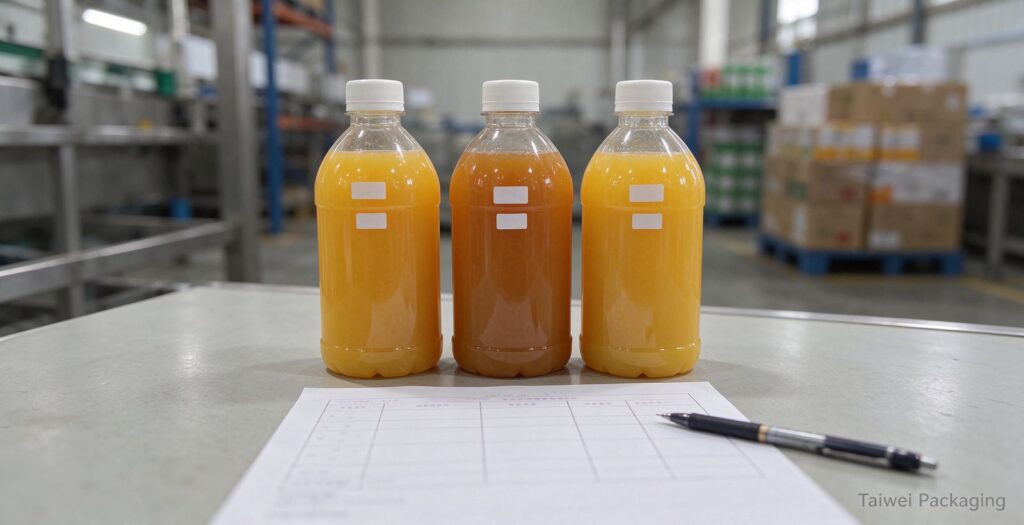
Photograph a darker bottle and a normal-looking bottle side by side under the same light, against the same background, and from the same angle. Keep exposure and white balance fixed when possible. Note condensation, differences in bottle tint, or labels that obscure the view. Photograph any swelling, leakage, or visible closure damage, then segregate and report the affected units under your company’s procedure. A consistent set of photos gives the factory a record it can compare with the physical samples. For a report of orange juice browning, record how many cases you inspected and how many showed the change. A photo from one case tells the team where to start. A record of inspected cases lets it see whether the affected cases cluster.
2. Why orange juice browning develops in storage
Ascorbic acid, or vitamin C, degrades during storage. Some of its breakdown products contribute to the formation of brown pigments. In acidic juice, sugar degradation can also contribute to nonenzymatic browning. Natural pigments such as carotenoids can change during storage as well, affecting the hue. The visible result of orange juice browning can be a darker or less vivid color. Several changes can contribute to that appearance.
Oxygen may already be dissolved in the juice at filling, remain in the headspace above it, or enter through the package during storage. Ascorbic acid can also degrade without oxygen, so even a package with a good oxygen barrier still needs appropriate temperature control. In one study of pasteurized orange juice stored at 4, 15, 20, and 25 °C, a drop in lightness appeared earlier at higher temperatures. The result helps explain why temperature belongs in an investigation. The study’s results apply to its juice and storage conditions.
If your site measures color, record the color difference, ΔE, using your existing method and name the reference sample. A laboratory can consider ascorbic acid or 5-hydroxymethylfurfural (5-HMF) when the investigation calls for supporting evidence of chemical change. These measurements help characterize orange juice browning. Establishing where the change occurred still requires traceable samples and records.( Study of chemical changes associated with browning.)
3. Check 1: Find a comparable retained sample
A shared lot code gets you started. Check the filling window, bottle and cap specifications, and the elapsed time between filling and comparison. Review the retained sample’s refrigerator history, including any transfer, outage, or change in light exposure. Compare the factory’s dispatch photos only if the lighting and packaging are comparable. When photographs differ, give priority to unopened physical samples you can inspect side by side. If you cannot match the filling window or verify storage, look for a closer comparison, such as bottles from the same run and package specification sent to another warehouse with complete records.
Compare three groups under consistent conditions where possible. Set the factory retain beside a darker arrival sample and a normal-looking arrival sample. If both retained and shipped samples have darkened, start with factors they share, such as filling conditions, package specification, and product age. If the retain still looks normal and only part of the shipment is darker, plot the affected bottles against both the filling log and the loading plan. That comparison makes orange juice browning easier to investigate because it shows which production or distribution records to pull first.
4. Check 2: Review filling and closure records
Suppose the darker bottles are scattered across several pallets but trace back to the same filling window. In a filling-line investigation of orange juice browning, match the affected bottles’ codes to the line’s start, stop, and restart times. Review the filling temperature, any available dissolved or headspace oxygen readings, and the cap lot used in that window. Check the applicable torque or seal inspection results. Compare with normal-looking bottles filled immediately before and after the affected interval.
A dissolved oxygen reading describes the juice at the recorded sampling point. A headspace reading describes the gas above the liquid in the sampled package. If the line measured oxygen only at startup, retain that reading as evidence for startup and flag the uncovered time window. A cap change or an out-of-specification closure check in the affected interval gives the team a specific comparison to make between retained and delivered bottles. If filling codes are mixed across the darker cases, check whether those cases shared the same loading position or handling route.( Tetra Pak Orange Book on sources of oxygen.)
5. Check 3: Match temperature records to pallet locations
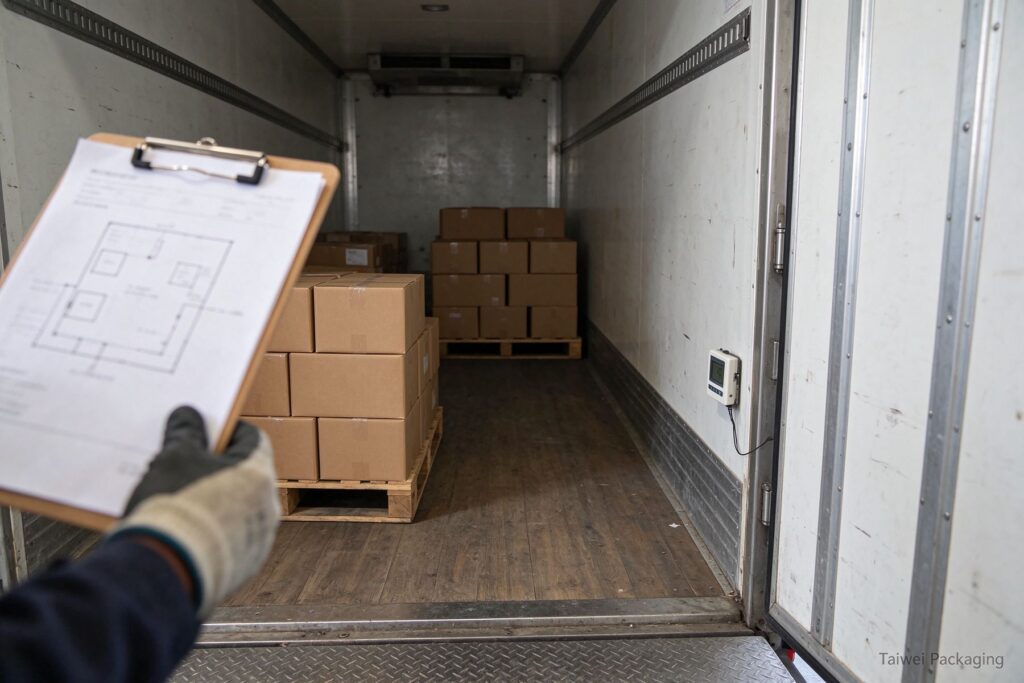
For suspected orange juice browning in transit, reconstruct the shipment timeline from cold-room exit to cold-room entry at the destination. Record loading and unloading times, transfers, trailer changes, and any wait before the pallets went back into refrigeration. Match changes on the temperature trace to events such as door openings or handoffs.
Next, check the logger ID, placement, calibration status, reading interval, and gaps. A logger mounted toward the front of the trailer describes conditions near that device. If the darker bottles came from pallets near the doors, look for location-specific records such as a second logger, the loading plan, unloading order, or product temperatures recorded at receipt. Identify air and product readings separately in the investigation notes. Also check the clocks on the logger and the warehouse records, particularly when a load crosses time zones. A door-opening entry and a temperature change can look unrelated if the records use different time references.
In the example, imagine that the darker cases span several filling windows but all come from two door-side pallets. Check whether those pallets waited longer during transfer or were the last to enter the receiving cold room. If the logger stopped during the handoff, flag that interval and request the warehouse and carrier records. The cluster gives you a place to investigate, and the records determine how firmly you can connect it to a temperature event.
6. Check 4: Decide whether to investigate the bottle, cap, or case
If the color difference tracks a particular cap lot or capping station, examine the neck finish, cap, and seal on affected bottles and normal-looking controls. Use your site’s closure integrity method if the inspection calls for it. If the pattern first appeared after a bottle or material change and the filling and storage records are comparable, test the original and replacement bottles under the same conditions. That helps you evaluate whether the new configuration contributes to orange juice browning during storage.
The outer case has a different job. It can shield bottles from light and protect them during handling. Before linking orange juice browning to an open or damaged case, document where and how long the bottles were exposed, if known. An open case found at receipt establishes its condition at that point. Earlier warehouse or transfer records help establish when the exposure could have started. If bottles also shifted or rubbed against each other, keep an original case and photograph the pack arrangement. Those records help the packaging team decide whether to test a change in shielding, bottle restraint, or case structure.( Taiwei corrugated box range.)
7. Document the findings and test one change
For an orange juice browning investigation, use the same sample ID on the bottle record, case photo, and receiving notes. The quality team should be able to work backward from a photo to the bottle, its pallet position, and the sample used for comparison.
| Sample or location | Record | Next action |
|---|---|---|
| Darker and normal-looking arrival samples | Lot, filling code, arrival time, pallet and case position, package condition, photo ID | Retain unopened samples and log their storage location |
| Factory retain | Filling window, package specification, temperature and light exposure history | Confirm comparability before measuring color |
| Shipment and transfer records | Logger ID and position, reading gaps, loading and unloading times | Match documented conditions to affected pallet positions |
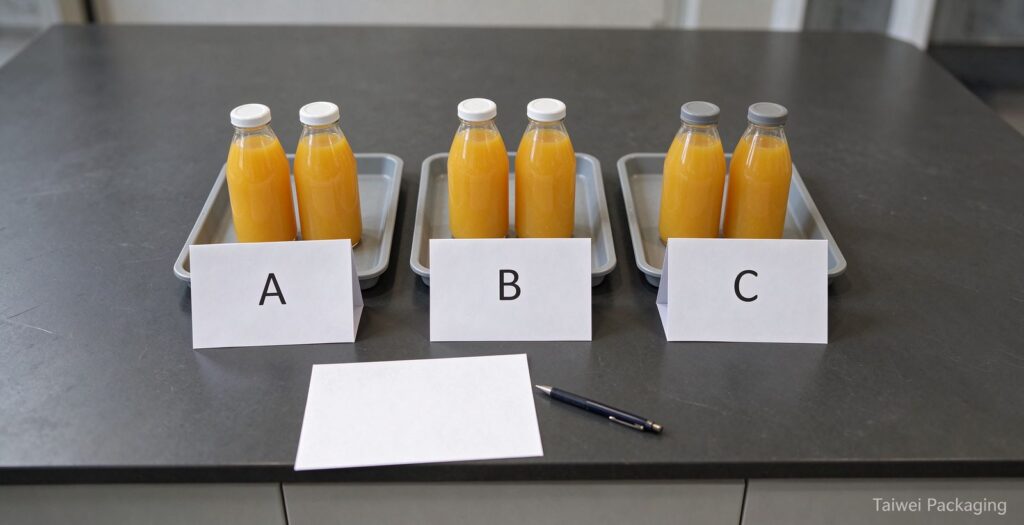
To follow up, the quality team can use three groups. Group A stays in the original package under the specified refrigerated conditions. Group B uses the original package and follows a controlled temperature profile based on the documented shipment conditions. Group C changes one package component, such as the cap, and follows the same storage conditions as Group A. Use juice from the same batch, keep comparable filling settings, and record initial color and subsequent readings at the same points in time.
Compare A with B to examine the effect of the temperature profile. Compare A with C to examine the effect of the cap change under the reference conditions. Repeat the same visual comparison at each observation point and retain the photos alongside the readings. If the groups start with visibly different colors, investigate that difference before attributing later orange juice browning to the tested change. Use the results to decide what to verify on a larger scale or monitor in the next shipment.
If the investigation also finds bottle movement, crushed cases, or inadequate shielding, share your bottle dimensions, bottle count per case, packed weight, pallet dimensions, and shipping method with Taiwei to discuss a corrugated case sample. ( Contact Taiwei Packaging.)
8. Frequently asked questions
Can you make a release decision based on orange juice browning?
Use the color difference to identify affected units and guide sampling. The quality team should use the product specification, process records, and any required testing to decide disposition. Handle swollen, leaking, or visibly damaged packages under your company’s procedure.
If the retain looks normal, did the shipment get too warm?
First verify that the factory retain and arrival sample are comparable. Then check whether the difference follows a filling window or a loading position. A time-stamped temperature record tied to the affected position strengthens the case for a temperature event. Log gaps as unresolved periods.
Can a higher-barrier bottle reduce orange juice browning?
Consider a trial if bottles start at a comparable color, filling and closure records are consistent, and the difference repeatedly follows the bottle specification. Use juice from the same batch and comparable storage conditions. Measure color at filling and at scheduled intervals to see whether the difference develops during storage.