
For an order of 3,000 gift boxes, collapsible rigid boxes quoted at $0.20 more per unit add $600 to the purchase price. But suppose flat-packed delivery saves $620 in freight and $360 in storage. The decision now turns on one question: how many extra seconds does it take to assemble each box?
The supplier’s unit price covers only part of the cost. Empty boxes have to reach the packing site, take up space until they are needed, and be ready when the team starts packing. Rigid inserts may also need their own cartons. To compare the two options, follow the same order from empty-box delivery through to finished gift boxes ready for dispatch.
תוכן העניינים
- How Collapsible Rigid Boxes and Set-Up Boxes Arrive
- Put Both Quotes on the Same Basis
- Calculate Freight and Storage from Real Packing Data
- Measure Assembly Time at the Packing Station
- Work Through a 3,000-Box Cost Comparison
- Match the Box Style to the Packing Workflow
- Check Samples and Request Comparable Quotes
- Frequently Asked Questions
- Request a Quote for Both Box Styles
1.How Collapsible Rigid Boxes and Set-Up Boxes Arrive
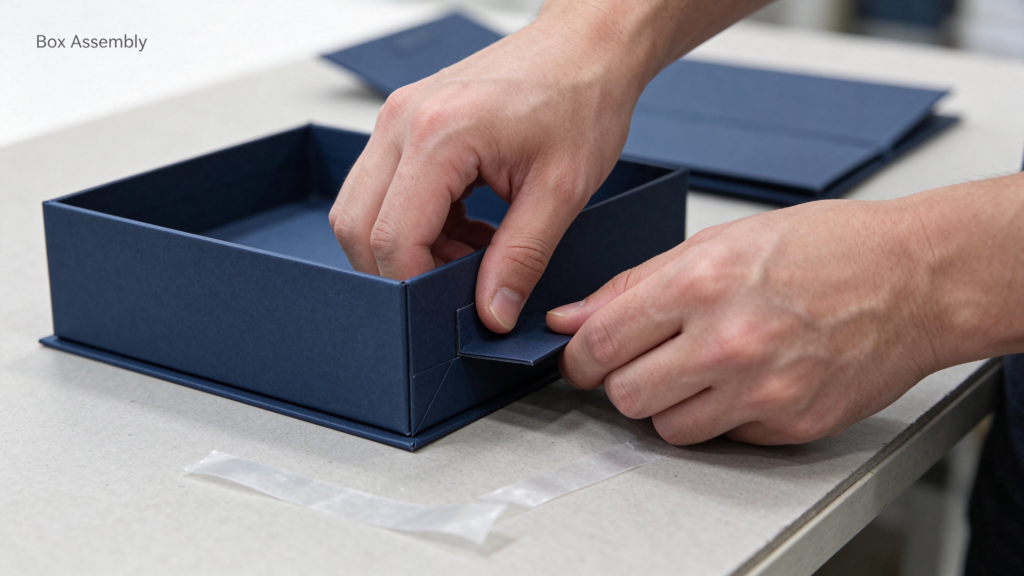
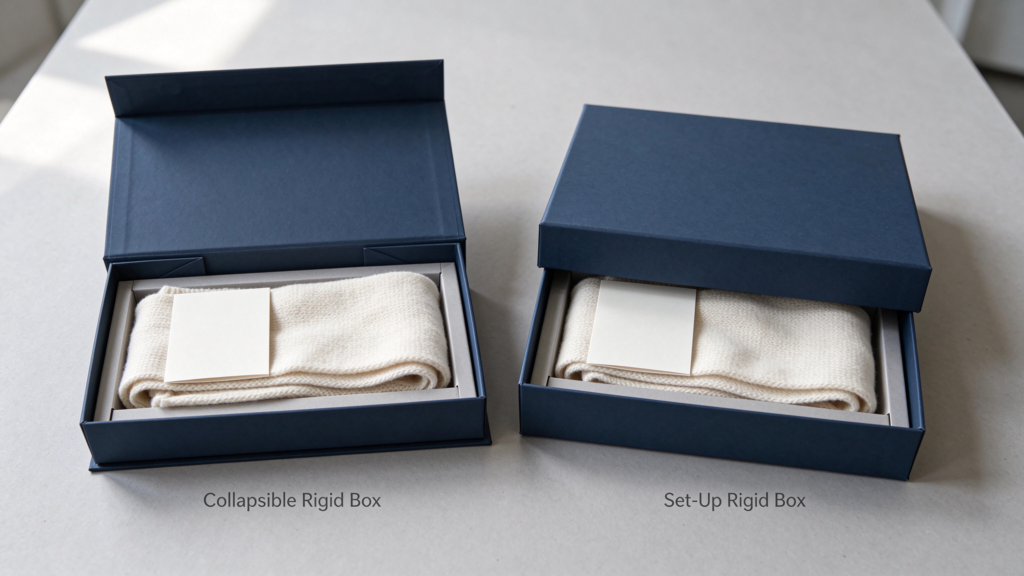
Collapsible rigid boxes are typically packed flat for delivery. At the packing site, an operator raises the side panels and secures the corners using adhesive tabs, locking features, or another method specified by the design. The rigid board holds the box’s shape once it is assembled.
A set-up rigid box arrives with its body already formed. After unpacking, the team can move directly to placing the insert and loading the product. In a two-piece lift-off lid design, both the lid and the base are formed at the factory. The supplier’s packing plan determines how the two pieces are arranged for transit.
Confirm the closure and the delivery configuration separately. A magnetic closure tells you how the lid stays shut. Ask whether that particular magnetic box ships flat or arrives assembled. A conventional folding carton is also typically supplied flat, but its board construction and assembly steps differ from those of a collapsible rigid box.
These two product examples show how the structures differ.
2.Put Both Quotes on the Same Basis
Start with the same product, accessories, and insert requirements. Ask for the same usable internal dimensions, printing and finish requirements, order quantity, and delivery point. The two structures may have different external dimensions. Both samples should accommodate the complete product set and meet the agreed presentation requirements.
Then check what each quote includes. Are magnets, corner adhesive tabs, and master cartons included in the box price? Will the insert come preinstalled, packed with the boxes, or shipped separately? Are sample and tooling charges billed separately or credited against the production order? Ask both suppliers to specify what their price covers through the agreed delivery point.
For apparel gift boxes, check the internal height with the entire set in place. A folded garment can sit higher once tissue paper, a hang tag, and an instruction card are added. Load both samples with everything the customer will receive and check how the lid closes before approving the dimensions.
3. Calculate Freight and Storage from Real Packing Data
Price the whole shipment
For each option, request the master carton dimensions, units per carton, carton count, gross weight, and total shipment volume. If the shipment is palletized, ask for pallet dimensions, loaded height, and pallet count. Include the carton count and volume for any inserts packed separately. A flat-packed box body can take up little space while a deep foam insert or formed plastic tray still occupies several cartons.
Ask a freight forwarder to price both packing plans for the same route, service, and destination. DHL Express compares actual and volumetric weight and uses the higher figure to calculate the charge. For full-container ocean freight, a smaller shipment may matter if it reduces the number of containers needed or frees space that can be used for other cargo. The same reduction in volume can produce different savings under different freight arrangements.
Base storage costs on when the boxes will be used
If your warehouse charges by pallet position and time occupied, estimate how long each position will remain in use. An order delivered all at once and drawn down over three months has a different storage profile from the same quantity delivered and used within a week.
If you lease a fixed amount of warehouse space, freeing rack positions may make room for other inventory or help you avoid temporary storage during peak season. Record any reduction in the storage bill in the cost comparison. Record the space freed separately so you can still assess its value to the operation.
4.Measure Assembly Time at the Packing Station
Ask the people who will pack the order to assemble and load a small batch of each sample. For the collapsible option, count the time spent raising the panels, peeling release liners, securing the corners, and checking lid alignment. Use the same finish point for both styles, such as when the insert and product are in place and the box has passed a visual check.
The difference between the two average times is the extra labor attributable to the box structure. Record any rework or rejected boxes during the trial so you can include those costs where relevant.
Additional assembly labor = extra seconds per box ÷ 3,600 × number of boxes to pack × hourly labor cost.
If a fulfillment provider charges per box, use its quoted fee and confirm whether that fee includes fitting the insert and checking the finished pack. If the work is done in-house, check the packing schedule as well. Ten extra seconds across 3,000 boxes adds about 8.3 labor hours. Those hours can be spread over several weeks of packing, but they need to fit into the day’s staffing plan if the entire order must ship at once.
5.Work Through a 3,000-Box Cost Comparison
Suppose an apparel brand needs 3,000 gift boxes and both samples meet its requirements for product fit, insert placement, and appearance. The figures below are illustrative and shown in US dollars. Both options share the same product-loading and closing steps, so the table counts only the extra assembly labor for the collapsible box.
| Cost item | Collapsible rigid boxes | Set-up rigid boxes |
|---|---|---|
| Box purchase price | $7,950 ($2.65 × 3,000) | $7,350 ($2.45 × 3,000) |
| Inserts | $1,050 | $1,050 |
| Samples and tooling | $150 | $150 |
| Freight for empty boxes and inserts to the same warehouse | $540 | $1,160 |
| Storage until use | $180 | $540 |
| Additional assembly labor at $36 per hour | $300 (10 extra seconds per box) | $0 |
| Total order cost | $10,170 | $10,250 |
| Average cost per box | $3.39 | $3.42 |
In this example, the collapsible option saves $980 in freight and storage. After the $600 difference in box price, $380 remains to cover extra assembly labor. At $36 per hour, the two options break even at about 12.7 extra seconds per box.
If assembly adds 10 seconds per box, the collapsible option saves $80 across the order. If it adds 18 seconds, extra labor rises to $540 and the set-up option costs $160 less. Once you have actual quotes, substitute your own freight, storage, and box-price differences to find the assembly time your order can absorb.
If the samples show different rejection rates, divide each option’s total cost by the expected number of usable boxes. Reworking corners, correcting poor lid alignment, or replacing boxes distorted by tight inserts can erase a narrow cost difference.
6.Match the Box Style to the Packing Workflow
| Purchasing scenario | What to compare first |
|---|---|
| Empty boxes ship internationally and are used in batches | Price the flat-packed option using the chargeable volume of the whole shipment. Check whether the warehouse can assemble each batch as needed and keep the remaining boxes flat. |
| A factory packs the whole order soon after the boxes arrive | Price the set-up option first. Fast inventory turnover may limit the storage savings from flat packs, while preformed boxes can move directly to insert and product loading. |
| Several stores receive small quantities and assemble boxes on-site | Compare stockroom space and assembly time during busy periods. Centralized assembly and assembly at the counter have different staffing and storage needs. |
| The design uses a deep insert or requires tightly aligned corners and lid edges | Review physical samples first. Check whether the inserts need their own cartons, whether fitting them distorts the box walls, and whether different operators can achieve a consistent finish. |
If empty boxes are delivered to the product factory and assembled immediately, any flat-pack volume savings apply to the trip to the factory. Price the finished shipment separately using the external carton dimensions and weight after the products are packed.
7.Check Samples and Request Comparable Quotes
Have your packing team handle both samples as they would on a production order. On the collapsible rigid box, inspect the wrapping paper along the fold lines, corner fastening, squareness, and magnetic lid alignment. On the set-up box, inspect the lid fit, edges, and wrapped corners. Check for pressure marks and scuffs after removing boxes from their shipping arrangement. Then put the actual product, insert, and accessories in each sample and check the fit, lid closure, ease of removal, and final appearance.
Use the same six inputs when requesting quotes for both options.
| Input | What to provide or request |
|---|---|
| 1. Product and accessories | Supply a physical sample or dimensioned drawing, the weight of each complete set, and a list of everything that goes inside. |
| 2. Finished box requirements | Specify usable internal dimensions, opening style, printing, wrapping paper, and finish. |
| 3. Insert configuration | Confirm the material and construction, whether the insert arrives installed, and whether it travels with the boxes or in separate cartons. |
| 4. Order terms | Use the same quantity, currency, delivery point, and required arrival date. Request separate line items for the box, insert, samples, and tooling. |
| 5. Shipping configuration | Request units per carton, carton dimensions, count, gross weight, and total volume. Request the pallet plan if applicable. |
| 6. Assembly requirements | Confirm how each box arrives. Ask for samples and assembly instructions, then time the work at the actual packing station and record any rework. |
Request the packing figures with the quote so your warehouse and freight forwarder can price both options before you approve production. Separate cartons for inserts or a more compact arrangement for lids and bases can change which quote costs less overall.Taiwei’s FAQs on samples and packing
8.Frequently Asked Questions
Do collapsible rigid boxes always cost more per unit?
The price depends on the specifications. A collapsible design may require extra work at the fold lines, corner fasteners, or magnetic components. A set-up box has its own forming and wrapping costs. Compare quotes at the same quantity and finish requirements, and check which structural components are included in each unit price.
Can a collapsible rigid box hold a heavy product during parcel shipping?
Start with the product weight, support points, and proposed insert. Place the loaded gift box in the intended shipping carton and evaluate the complete pack for its distribution conditions. A sample that closes cleanly confirms the fit at the packing table. It still needs to be assessed for the impacts, vibration, and stacking loads it will face in transit.
Can set-up rigid boxes be nested to save space?
Some designs allow lids and bases to be packed separately or nested in an arrangement the supplier has checked. Ask for the actual units per carton and photos of the packing arrangement. Check whether protective sheets are needed, how easily the pieces can be separated, and whether their surfaces scuff in transit or during unpacking.
Can both box styles use the same insert?
Check the usable internal dimensions, corner construction, insert seating, and clearance under the lid. Boxes with the same nominal dimensions can offer different usable space where corner tabs or magnetic components sit. Fit the same insert and the actual product into both samples before specifying one insert for both styles.
9.Request a Quote for Both Box Styles
Once both samples meet your packing and presentation requirements, compare the box and insert price, freight to the warehouse, storage costs, and assembly labor. If the totals are close, check the shipping configuration and repeat the assembly trial. A few seconds per box or a change in carton count can shift the cost of the entire order.
Planning rigid packaging for apparel, gifts, or a branded product set? Share the product and accessory dimensions, estimated quantity, delivery location, and who will assemble and pack the boxes. Ask to compare flat-packed and preassembled delivery for the same product and order.