
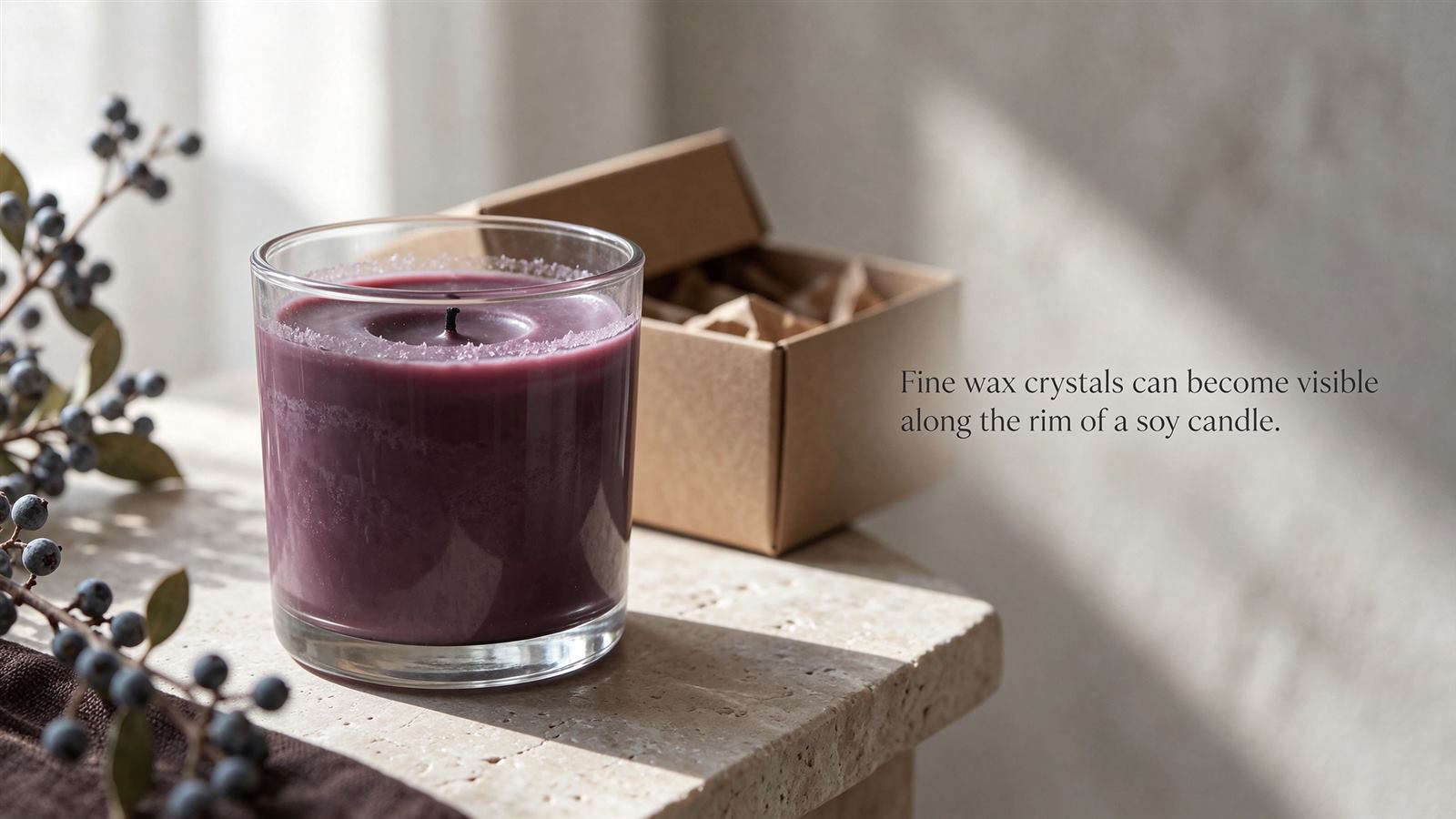
You open a dark soy candle and notice a pale ring around the wax surface. Through the glass, there is also a patch that looks like a water mark. Soy candle frosting is the visible growth of tiny wax crystals, usually on the top or sides of the wax. The water mark may be a wet spot, where the cooling wax has pulled away from the glass. If you see fuzzy growth, foreign material, or pooled liquid, or notice a musty odor when you open the jar, leave the candle unlit and contact the seller.
For a candle brand, the same complaint raises two questions. When did the white marks first become visible, and do they exceed the agreed appearance limits for this product? Answering those questions starts with comparing the delivered candle with a retained unit from the same batch under the same viewing conditions.
Contents
- How to check white marks on a soy candle
- Why soy candle frosting can appear after the wax sets
- How to trace white marks through storage, shipping, and retail
- How to set appearance limits and keep usable retained samples
- מַסְקָנָה
- שאלות נפוצות
1. How to check white marks on a soy candle
Set the unlit candle in diffuse daylight. Look down at the wax surface, then slowly rotate the jar to inspect the sides.
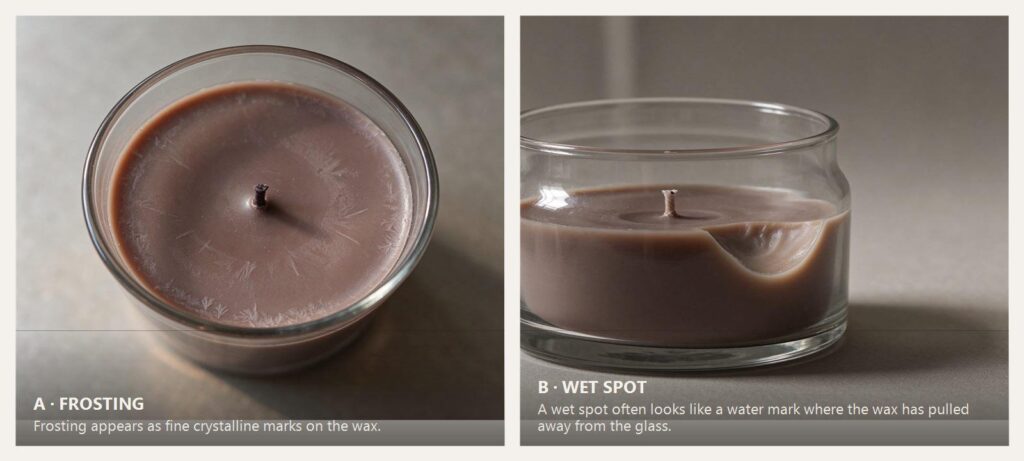
- Look at the shape and location. A pale haze or fine crystalline pattern on the wax is consistent with soy candle frosting. A sharply outlined patch visible mainly through the glass may be a wet spot. Both can appear on the same candle.
- Report any texture you already noticed. If you already touched the area and it felt dry and waxy, tell the seller. Leave suspicious raised patches or deposits undisturbed.
- Report any odor you noticed on opening. Tell the seller about a distinct musty, earthy, or otherwise unusual odor. A normal scent is one clue, and there is no need to lean in for a closer sniff.
Photos show shape and location. The customer can describe texture and odor if they already noticed them, but these clues alone cannot establish what the deposit is. Ask for a top view, a side view, and a photo of the lot code. If the jar shifted out of its insert, the lid moved, or the glass cracked, ask for photos of those conditions as well.
On the product page, a photo of light soy candle frosting on the same wax color and jar style shows buyers what to expect. A box insert card can give a short explanation and tell customers when to contact the seller. Keep the lot code easy to find after opening. An opaque original box can keep direct light and dust off an unused candle when stored according to the product instructions.
2. Why soy candle frosting can appear after the wax sets
Soy wax is commonly made from hydrogenated soybean oil. Its triglycerides can pack into several crystal forms, a property called polymorphism. As the poured wax cools, crystals form. They can continue to rearrange with time and temperature changes after the wax has solidified. Fine crystals may become visible only later, and the contrast makes them easier to see on dark wax.
2.1 Check the raw wax and its packaging
When wax arrives, inspect any moisture barrier liner and its seal. Check whether the outer packaging and storage location keep direct sunlight off the wax. Record when the liner was opened and resealed, then link the supplier’s wax lot to the finished candle batch. If complaints cluster, those records let you compare pours made with the same wax lot before and after extended storage or with different opening dates.
Follow the technical sheet for the wax grade in use. For example, Cargill recommends cool, dry storage away from direct sunlight for unopened NatureWax C-3. That guidance applies to the raw material. Cargill NatureWax C-3 product data.
2.2 Check jar temperature, cooling, and packing time
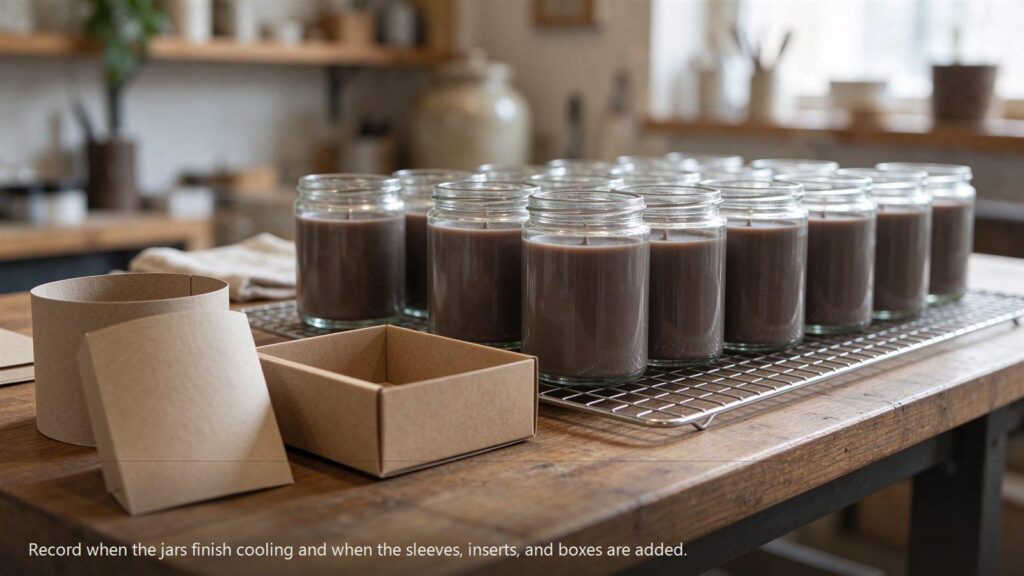
Record pour temperature, starting jar temperature, and cooling position. Note whether the jars came from a colder stockroom and where the sleeves, inserts, and gift boxes were kept. Record when each packaging component was added and when the shipping cartons were closed and stacked.
If the candles went into stacked cartons while still cooling, compare the cartons at the edge and center of the stack. If packing began after cooling was complete, check the stack as part of the storage investigation. At packing, also check that the insert restrains the jar and leaves enough clearance for the lid.
For a small follow-up trial, keep the wax lot, formula, and jar the same and change one condition at a time. Compare two cooling positions in one trial and two packing times in another. Inspect each group at the same elapsed time under identical lighting. If the wax grade, fragrance, or dye recently changed, test each change separately to see whether the soy candle frosting recurs. CandleScience soy wax cooling and troubleshooting guidance.
3. How to trace white marks through storage, shipping, and retail
Open a carton from the oldest stock of the same product to see whether the problem warrants a wider inspection. To investigate a specific complaint, pull an unopened unit from the affected batch in its original packaging. Compare it with release photos, the delivered unit, and any retail display sample. Record the batch, opening time, and viewing conditions for each.
3.1 Warehouse storage
Inspect corrugated shipping cartons for dampness, softening, or crushing. Check whether any moisture barrier liner stayed sealed and whether opaque packaging remained closed. If marks cluster in cartons near a window, wall, or the center of a stack, compare them with cartons from the same batch stored elsewhere. To test whether packaging moderates temperature or humidity changes, log conditions inside and outside the carton over the same period.
Where the finished product has no storage specification, YS Candle’s guidance offers a starting point for investigation: a stable 15–24°C, relative humidity below 60%, and protection from direct sunlight. Record the size of daily fluctuations, how long excursions lasted, and which cartons were exposed. Use those records to decide where to investigate first. Release decisions follow the product’s agreed acceptance criteria.
3.2 Shipping and transfer points
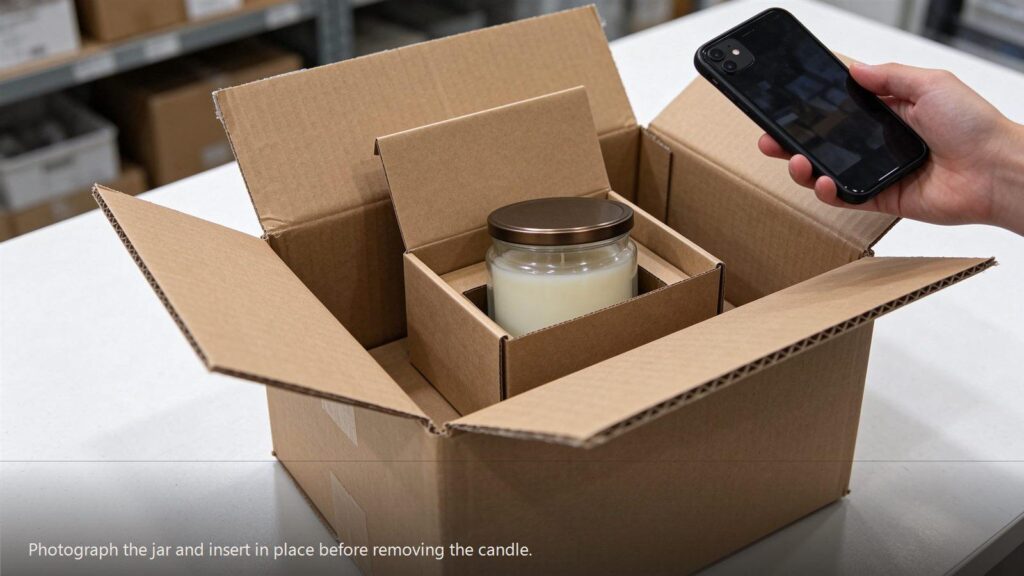
Before opening a delivered carton, photograph crushed corners or loaded panels. After opening, take a photo before lifting the jar. Check whether the jar has left its recess, the lid has shifted, or the insert has deformed. Then photograph the white marks and any scuffs. Compare the photos with the retained unit and align them with the shipment’s temperature records. If a transfer point shows a clear temperature excursion, compare units from the same batch that traveled a different route before drawing a conclusion.
When comparing cushioning paper, honeycomb paper, or foam, change one material or restraint detail per trial. Choose a test that reflects the actual distribution route. Photograph samples before and after under the same lighting and angle. Record carton damage, jar movement, and changes in the appearance of the wax separately. A matched comparison helps determine whether vibration or compression changed the wax-to-glass contact or made an existing wet spot more visible.
3.3 Distribution and retail display
Take a window-box display unit and a closed-box stock unit from the same batch. Photograph the display unit as the customer sees it on the shelf. Record display duration, location, and light direction. Then open both boxes and photograph the top and sides at the same distance in the same diffuse daylight.
If the apparent difference shrinks under matching conditions, check the window orientation, side lighting, and background first. If a difference remains, review display duration, light exposure, and temperature alongside the retained sample. A photo of typical frosting on the product page or insert card can help retail staff explain what the customer is seeing.
4. How to set appearance limits and keep usable retained samples
Typical soy candle frosting can be a normal change in the wax. A gift candle can still have a measurable appearance limit. Before production, agree on the exact formula, color, jar, and packaging configuration used for approval, then document the following conditions.
4.1 Keep samples in the packaging customers receive
Retain units with the production jar, sleeve, insert, gift box, and shipping carton. Record the finished batch, raw wax lot, packaging version, sealing date, and storage location. If the team needs to assess the first opening at release and again after an agreed storage period, reserve a separate unopened unit for each inspection point.
4.2 Fix the timing, lighting, and viewing distance
Agree when to inspect at release, after storage, and on receipt if applicable. Record the opening time, the actual inspection time, and any agreed waiting period after opening.
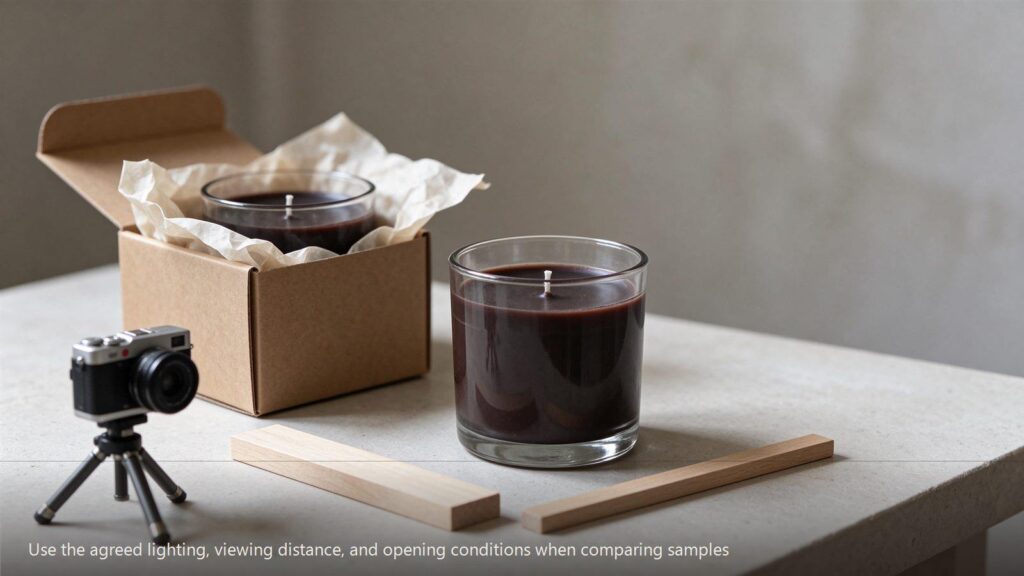
One workable setup is diffuse daylight and a viewing distance of about 30 cm. Inspect the top and sides separately, then photograph them with a consistent background and angle. Label each image as a through-window view, an in-package view, or a first-opening view. For window boxes, keep both the through-window photo and the photo taken after opening. Use the setup approved for the product when judging the batch.
4.3 Define the acceptable, borderline, and out-of-limit samples
Approve physical reference samples and matching photos for the top and sides. Specify the extent and density of soy candle frosting allowed. If there is a coverage limit, define the visible area used as its denominator. Record wet spots, jar displacement, and glass damage against their respective criteria. If the through-window appearance is part of the purchase specification, judge it against its own approved reference.
4.4 Agree on sampling, reinspection, and release
Define the lot, the number of cartons and units to inspect, the number of out-of-limit units allowed, and the action to take when a result is borderline or exceeds the limit. Keep the sample, lot code, photographs, and decision record for reinspection. Record storage excursions alongside the inspection findings so the team can investigate them with the relevant samples.
5. מסקנה
If you see white marks on a soy candle, check the wax surface and the glass side in diffuse light. If you notice signs of possible contamination, leave the candle unlit and contact the seller. For brands, a same-batch retained sample in the original packaging helps answer what changed. Agreed viewing conditions and physical references help determine whether the product meets its appearance specification.
If you are specifying a box for a glass jar candle, send Taiwei the jar diameter, height, lid dimensions, sales channel, and shipping method. These details help us discuss insert fit, window placement, and the shipping carton. Taiwei custom packaging services.
6. Frequently asked questions
6.1 Does soy candle frosting affect burning or fragrance?
Typical soy candle frosting mainly affects appearance and generally does not change how the candle burns or smells. Use the product’s established burn-test requirements to assess burning performance.
6.2 Why did the candle look clear at release but show frosting on arrival?
Crystals can rearrange after the wax sets, so a white pattern may become visible during storage. Arrival is the time the mark was observed. Compare the release photos, an unopened retained unit from the batch, and the delivered candle under matching conditions to narrow down when it became visible.
6.3 How can I quickly tell a wet spot from frosting?
Slowly turn the unlit jar in diffuse light. A smooth-edged patch that looks like a water mark behind the glass often points to local separation of the wax from the jar. Fine white crystals on the wax surface or sides are more consistent with frosting. You can make this initial check without pressing on the wax.
6.4 What can a candle gift box do?
A fitted insert can restrain the jar, and a closed opaque box can shield it from direct light. The lot label and insert card support traceability and customer service. To find out whether a specific packaging configuration buffers temperature or humidity swings, log conditions inside and outside the packed carton during a storage or shipping trial.