

Across packaging sourcing, the sustainable packaging trends 2026 brings together tighter regulation, recycled materials, design for recyclability, and EPR cost pressure. For years, “eco-friendly packaging” was mostly a talking point in brand storytelling; in 2026 it has become a regulatory threshold, a procurement baseline, and a cost line on the balance sheet.
This guide breaks down the seven sustainable packaging trends that matter most to packaging material and sourcing decisions in 2026. For each one, we cover what is driving the change, the specific requirements, the impact on cost and supply chain, common approaches, and the trade-offs buyers should weigh. A procurement checklist and a supplier trade-off scenario follow at the end.
Contents
- Regulation Has Become a Hard Requirement — The PPWR Turns Compliance into a Document Obligation
- Recycled Materials Replacing Virgin Inputs — The Shift Is from “What Material” to “Can the Source Be Proven”
- Designing for Recyclability — Mono-Materials, Fewer Composites, Easy Separation Become the Structural Mainstream
- Minimization and Lightweighting — Right-Sizing Solves Compliance, Freight, and Carbon at Once
- Bio-Based and Compostable Materials Have Crossed the Price Threshold — but Adoption Depends on End-of-Life Infrastructure
- Reuse and Refill Move from Brand Pilots to Policy Targets
- Traceability, Transparency, and EPR Fee Linkage — Sustainability Enters the Cost Model
- Frequently Asked Questions
- Wniosek
Trend 1: Regulation Has Become a Hard Requirement — The PPWR Turns Compliance into a Document Obligation
1.1 From Directive to Regulation: Why the Rules Tightened Suddenly
Ten EU Packaging and Packaging Waste Regulation (PPWR, Regulation (EU) 2025/40) entered into force on 11 February 2025 and has applied across all 27 Member States since 12 August 2026. It replaces the packaging directive in place for nearly 30 years. The key difference is legal force: the old directive had to be translated into national law in each country at different speeds, while the regulation applies directly and uniformly across all Member States — and it also covers packaging imported into the EU from outside.
1.2 What Applies Now, and What Phases In Later
Provisions already applicable since 12 August 2026:
- Declaration of Conformity and technical file:Each packaging type placed on the EU market requires a manufacturer-issued declaration of conformity, supported by a technical file covering material composition, test results, and design documentation that can be produced during audits.
- Heavy metal limits:The combined sum of lead, cadmium, mercury, and hexavalent chromium must not exceed 100 mg/kg.
- PFAS restriction:Food-contact packaging containing per- and polyfluoroalkyl substances (“forever chemicals”) above set thresholds may no longer be placed on the market. The first affected products are grease- and water-resistant food packaging such as baking paper, pizza boxes, takeaway containers, and microwave popcorn bags.
- General minimization obligation (qualitative standard):Packaging weight and volume must be limited to what is necessary for protection, hygiene, and safety. This is a qualitative requirement that applies from August 2026; it carries no fixed percentage on its own. It is important to separate this from the 50% empty-space ratio, which is a separate numerical rule under Article 24 that does not take effect before 2030 (see Trend 4).
Requirements phasing in around 2030:
- Recyclability grades:Packaging is graded A–E. From 2030, packaging placed on the market must reach at least Grade C; the threshold rises to Grade B by 2038, and lower-grade packaging will gradually exit the market.
- Recycled content targets: Plastic packaging must contain a minimum share of post-consumer recycled material, with targets stepping up through 2030 and 2040.
- Empty-space ratio: The 50% numerical cap for transport, grouped, and e-commerce packaging is covered in Trend 4.
- Labels and reuse: Harmonized sorting labels and material markings are being phased in; where feasible, reuse or refill options must be offered at no extra charge.
1.3 What This Means for Buyers
Compliance pressure no longer sits only with the brand; it runs down the supply chain to packaging suppliers and importers. If materials, structure, and documentation do not meet the rules of the target market when a new SKU is planned, late-stage rework — new samples, material switches, or box redesigns — costs far more than planning upfront. For products shipping to the EU, compliance checks should be moved into the RFQ stage rather than handled after bulk production.
1.4 Action for Buyers
- Build a market-specific compliance checklist (material restrictions, recycled content, recyclability grade, labeling, declaration of conformity) into your sourcing requirements.
- Ask suppliers to state material composition and the test/certification documents they can provide; do not rely on verbal “eco-friendly” claims.
- Prioritize highest-volume, EU-bound products when auditing existing packaging first.
Trend 2: Recycled Materials Replacing Virgin Inputs — The Shift Is from “What Material” to “Can the Source Be Proven”
2.1 Where Substitution Is Happening
Recycling substitution runs along two tracks. On the plastic side, RPET and recycled HDPE replace virgin plastics; on the paper side, post-consumer recycled corrugated and paperboard replace virgin pulp. Beyond the environmental story, recycled materials often map to lower end-of-life fees and easier compliance under EPR schemes and recycled-content thresholds.
2.2 Recycled Resin Is Not One Category — Split the Source
Recycled material falls into two broad types with different cost, performance, and compliance standing:
- Post-consumer recycled (PCR): Material recovered from packaging and products after consumer use. It carries the strongest environmental and compliance credibility, but supply stability, batch color variation, and cleanliness can fluctuate more.
- Post-industrial recycled: Production offcuts and waste material recovered and reused. Quality is more stable, but it is recognized less strongly than PCR in some regulatory and brand-disclosure contexts.
When sourcing, track recycled ratio, material source, batch stability, color consistency, print suitability, and whether traceable proof of source is available.
2.3 The Price Relationship Is No Longer a Fixed Premium
A common assumption to update: recycled material is not necessarily more expensive than virgin material. In 2026, some recycled plastic grades in parts of Europe traded below virgin prices, while food-grade recycled PET in Asia still carried a premium of several hundred U.S. dollars per tonne. The direction of the virgin-to-recycled price gap varies by material category, region, and time of year, and cannot be generalized.
The sourcing strategy should therefore not rest on the assumption that recycled material always commands a premium that has to be accepted gradually. It should be evaluated dynamically by category, destination market, and quotation window. The cost premium for recycled paperboard tends to be more stable, but stiffness, whiteness, batch variation, and print suitability remain real performance constraints that cannot skip sample testing.
2.4 Action for Buyers
- Specify recycled ratio and type (PCR vs. post-industrial) and acceptable batch variation in the contract.
- Require source proof and relevant certification for recycled material.
- Compare landed cost of virgin and recycled options at current market prices, then weigh EPR fees and compliance requirements together — do not assume recycled is automatically more expensive or cheaper.
When comparing quotes, review supplier certifications and one-stop packaging service alongside price — material proof, test reports, and in-house structure design all affect whether an order can land on time.
Trend 3: Designing for Recyclability — Mono-Materials, Fewer Composites, Easy Separation Become the Structural Mainstream
1 From “Claimed Recyclable” to “Designed Recyclable”
Many packages have carried a “recyclable” label while being built from multiple materials that recycling facilities cannot effectively separate and recover. The regulatory direction is clear: recyclability must be engineered backward from the recycling process — whether the material sorts easily, whether it enters the right recycling stream, and whether separation is economically viable. Packaging that fails design-for-recycling criteria will not be recognized as recyclable regardless of the symbol printed on it.
3.2 Main Structural Changes
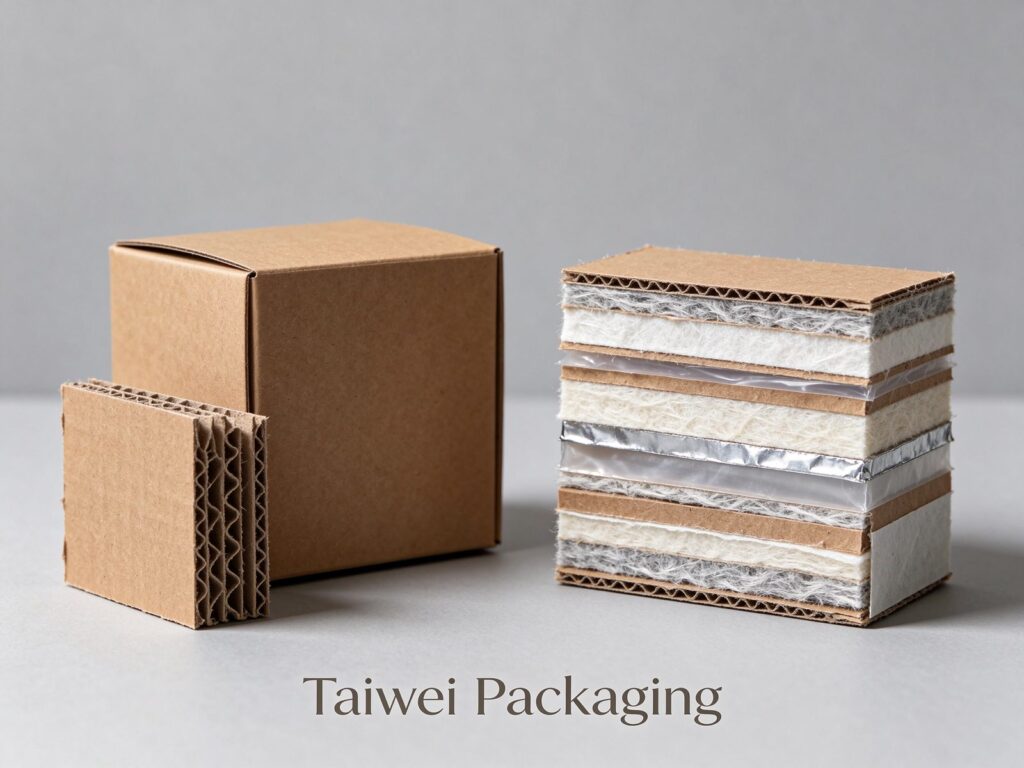
- Mono-material conversion: Heterogeneous composites such as PET+PE or paper-plus-plastic film are moving toward single materials — Mono-PET, Mono-PP, or pure paper-based structures — to raise recovered-material purity.
- Removing unnecessary laminates and coatings: Films and heavy coatings that impair recycling are being simplified; moisture-barrier needs are met where possible within a single material.
- Easy-separation design: Box structure, inserts, labels, and closures are designed for disassembly at the outset, avoiding permanently glued, hard-to-separate components.
- Simplified decoration: Excessive foil stamping, decorative layers, and non-essential add-ons give way to function-first minimalist structure.
3.3 The Grade System Sets the Design Threshold
EU recyclability is graded A–E based on material compatibility, separability, and recycling-stream fit. From 2030, packaging must reach at least Grade C; from 2038 the bar rises to Grade B. This means recyclability assessment has to enter box development early, not be judged after the finished pack is fixed.
3.4 Trade-Offs
A single material often requires finding new solutions for barrier performance, moisture resistance, or premium feel: after removing a plastic film, surface moisture protection, scuff resistance, and print finish rely on paper grade, water-based inks, and surface treatment. The design phase has to balance recyclability against protection, appearance, and cost — which is where structural design input adds the most value.
3.5 Action for Buyers
- Involve the packaging supplier in material and structure review at the early sampling stage.
- Prioritize simple structures, single materials, and easily separable components.
- Audit existing composite packaging for recyclability and flag the hardest-to-recover parts (films, composite inserts, non-paper labels).
For high-volume shipments, review corrugated shipping box structures — flute profile, board grade, and divider layout — early in design to keep recyclability and strength in balance.
Trend 4: Minimization and Lightweighting — Right-Sizing Solves Compliance, Freight, and Carbon at Once
4.1 Two Separate Rules: The Qualitative Minimization Duty and the 50% Empty-Space Cap
The PPWR minimization rules need to be read as two distinct mechanisms:
- General minimization duty (qualitative): Packaging weight and volume must be reduced to the minimum needed for protection, hygiene, and safety. This qualitative duty applies from August 2026, with no universal percentage. Double walls, false bottoms, and added layers used only to make a product look larger will not be accepted.
- 50% empty-space ratio (Article 24 numerical rule): This is an independent numerical requirement for transport, grouped, and e-commerce packaging. It takes effect no earlier than 1 January 2030. The calculation methodology is due from the European Commission by 12 February 2028; if the methodology is delayed, the rule applies three years after it enters into force, whichever date is later. Filling materials — air cushions, bubble wrap, foam chips, paper shreds, and wood wool — all count as empty space.
4.2 Two Exemptions Worth Confirming Before Sizing
The 50% cap does not apply to every shipping model. Under the Article 24 derogations, sales packaging used directly as e-commerce packaging, and reusable packaging operating within a reuse system, are not directly subject to the 50% cap; both still remain bound by the general minimization duty. Before setting right-sizing targets, confirm whether your shipping model falls under either exemption, rather than applying the same empty-space calculation to every SKU.
4.3 Three Levers for Reduction
- Right-sized box dimensions: Set internal dimensions from actual product measurements and arrangement, removing the spare space kept for generic use.
- Structural lightweighting: Achieve compression and drop performance through flute profile pairing, high-strength fine fluting, and optimized scoring and slotting — not by thickening board or adding layers.
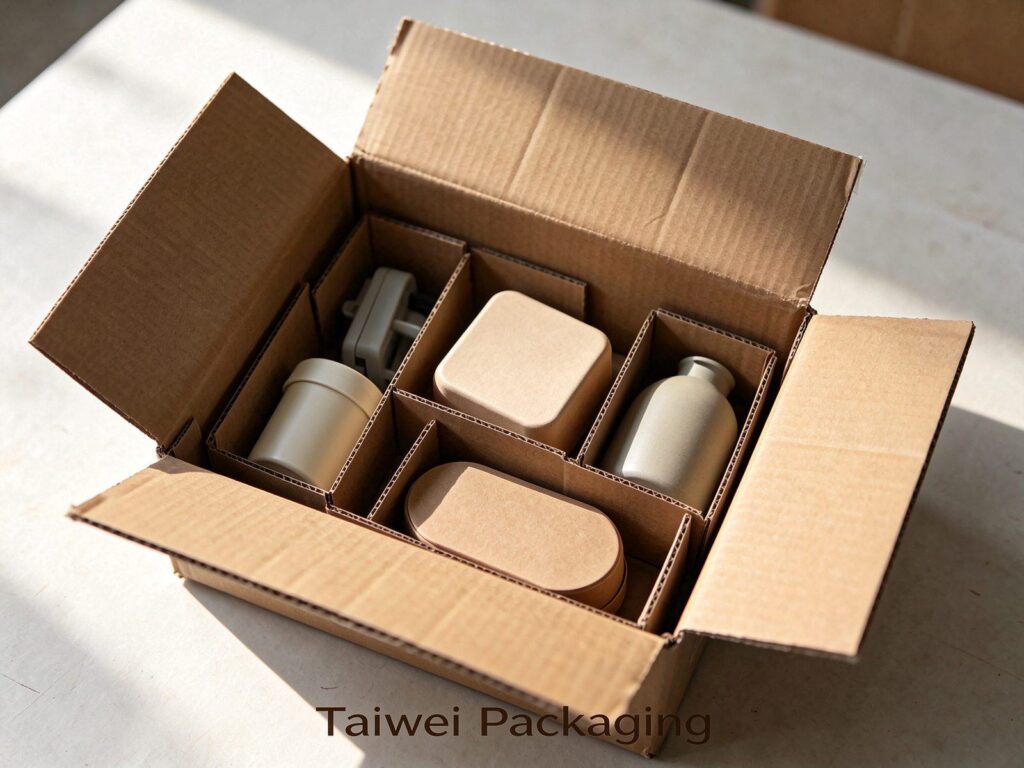
- Inserts replacing void fill: Secure products with paperboard dividers, cradles, and molded pulp inserts in place of some foam and bubble wrap, while cutting filler volume.
4.4 The Business Case: Reduction Is Not Just an Environmental Obligation
Lower volume and weight feed straight into logistics cost: parcel and freight are billed on dimensional weight, so a tighter box improves per-parcel dimensional weight, container loading, and warehouse footprint; lower material use also reduces per-unit packaging cost. For e-commerce sellers, right-sizing is usually the most immediate-return improvement — optimize the box first, then upgrade materials.
4.5 Trade-Offs and Limits
Reduction cannot come at the expense of protection: irregular, fragile, liquid, and multi-item products still need reasonable cushioning, and the empty-space methodology leaves room for irregular shapes and shipping labels. The target is protection that is “just enough,” not packing the box to the absolute limit.
4.6 Action for Buyers
- Recheck existing box dimensions against actual product measurements and list excess space and non-essential cushioning.
- Confirm first whether your shipping model qualifies for an exemption before choosing an empty-space calculation basis.
- Compare compression performance and material use across flute profiles and box styles to balance protection against reduction.
- Evaluate paperboard inserts and cradles as alternatives to foam cushioning.
Trend 5: Bio-Based and Compostable Materials Have Crossed the Price Threshold — but Adoption Depends on End-of-Life Infrastructure
5.1 Material Landscape and Use Cases
Bio-based and compostable materials in practical use today each have their own positioning:
- PLA (polylactic acid, corn-starch based): Good clarity, suited to clear windows and containers; composting takes months and requires industrial composting conditions.
- Bagasse (sugarcane fiber): Fiber structure suits food trays and containers, with relatively good heat resistance.
- Mycelium: Suited to protective inserts and cushioning, moldable into shape.
- Seaweed film: Suited to sachets and wraps; still at an early industrial stage.
- Kraft paperboard and corrugated board: The baseline paper-based option, with the most established recycling path.
5.2 Cost Tiers Need to Be Separated, Not Treated as One Bracket
The cost reality differs widely within bio-based packaging, and “crossed the price threshold” mainly applies to paper-based routes:
- Compostable plastics (PLA-led): The cost premium over conventional plastic remains significant, still in a high-premium range; moisture resistance, load-bearing, and long-term storage performance are also weaker than conventional plastic, and each category needs validation.
- Bagasse, bamboo, and molded pulp paper-based routes: Premium has narrowed to a low single-digit to mid-teens percentage range, making this the more mature, lower regulatory-risk alternative today.
These percentages are rough order-of-magnitude references only; actual pricing moves with resin markets, formulation, and order quantity, and final selection should rely on current supplier quotes and sample testing.
5.3 The Most Overlooked Precondition: End-of-Life Infrastructure
“Compostable” does not mean it will actually be composted. Compostable packaging requires industrial or home composting facilities at the destination; where infrastructure is lacking, compostable packaging mixed into the regular recycling stream can contaminate sorting. The sourcing order should therefore be: confirm the end-of-life conditions in the destination market first, then decide whether to use compostable material — not pick the material first and look for an outlet later.
5.4 Action for Buyers
- Verify recycling and composting infrastructure in the target market before locking the material direction.
- Request degradation conditions, applicable product categories, heat/oil resistance, and food-contact compliance information.
- Where infrastructure is unclear, prioritize simple, recyclable paper-based solutions.
Trend 6: Reuse and Refill Move from Brand Pilots to Policy Targets
6.1 The Regulatory Reuse Targets
The EU has set phased reuse targets for transport and grouped packaging: at least 40% of cross-border transport packaging must be reusable in a reuse system by 2030, with a 70% endeavor level for 2040; for grouped packaging, non-cardboard box formats carry a 10% target in 2030 and a 25% endeavor level in 2040. Deposit-return systems are being strengthened, and reuse or refill options must be offered where feasible, with no extra charge for choosing reuse.For a plain-language breakdown of the PPWR reuse targets and empty-space rules, see the Newwen PPWR overview.
One exclusion matters directly to cardboard exporters: cardboard boxes are not covered by the transport packaging reuse target, and the 10% grouped-packaging target applies only to box formats other than cardboard. In other words, brands exporting with corrugated boxes face limited reuse-side pressure; their main constraints sit on recyclability and minimization, not reuse.
6.2 Which Categories Make Reusable Packaging Work First
The economics of reusable packaging depend on turnover frequency, standardization, and a stable return path. Categories with fixed routes, high-frequency replenishment, and standardized products — retail restocking, industrial goods, standardized accessories — are the first to adopt reusable crates. Brands with highly variable styles, long-tail SKUs, and complex return routes still face relatively high recovery and cleaning costs for reusable systems. Rules also differ between internal-site or domestic intra-country movements and cross-border flows, so assess against the actual logistics route.
6.3 Approach for Single-Use Packaging
For categories not yet suited to circular systems, the priority is to make single-use packaging recyclable, easy to disassemble, and low in material — not to add extra structure for a hypothetical second use. Refill is a separate path: keep the primary container, replace the inner pouch, cutting repeat packaging material while supporting repurchase design.
6.4 Action for Buyers
- Assess your category’s turnover frequency and logistics routes to judge whether reusable packaging has an economic case.
- Keep single-use packaging focused on recyclable structure and easy disassembly.
- Track deposit-return and recycling-system requirements in destination markets.
Trend 7: Traceability, Transparency, and EPR Fee Linkage — Sustainability Enters the Cost Model
7.1 Documentation Becomes Part of the Package
Declarations of conformity, material composition records, QR codes or digital markings, and third-party certification are increasingly required alongside the package itself. Brands must be able to prove to regulators and downstream customers what materials were used, how much recycled content is present, and whether the package is recyclable; whether a supplier can provide these documents directly affects whether an order can land.
7.2 EPR Fees Are Tied to Environmental Performance — and the Gap Is Quantifiable
Under EPR, producers pay for end-of-life handling, and the fee is usually modulated by material, recyclability, and recycled content: easier-to-recycle packaging with higher recycled content carries a lower unit fee; hard-to-recycle composites and virgin plastics carry higher charges.
This gap is not a rounding difference. As an example, France’s eco-modulation scheme, in force from 1 January 2026, rewards packaging containing post-consumer recycled plastic by tonne: the bonus for closed-loop recycled material is around €550 per tonne, and around €450 per tonne for open-loop material (applicable to 2026–2027, subject to traceability certification, recycling yield, and other conditions). This is a single member state and single fee scheme only; absolute values differ widely across markets, but the direction is consistent: recyclability and recycled content are becoming explicit variables on the EPR invoice.
7.3 The Costs Easily Missed in Price Comparison
Comparing factory unit price alone tends to leave out three hidden costs: end-of-life and EPR fees, compliance documentation and certification costs, and rework or return risk from non-compliance. Only when these are included can you see the full lifecycle cost; a solution with a slightly higher upfront price but good recyclability and complete documentation may cost less over time.
7.4 Action for Buyers
- Write certification, traceability documents, and EPR responsibility split into the supplier evaluation sheet.
- Prioritize suppliers that can provide material proof and test documentation.
- Evaluate full lifecycle cost at the concept stage, not just unit price.
Procurement Checklist: Applying the Sustainable Packaging Trends 2026
- Is your current packaging material composition clearly listed, with recycled-material types distinguished?
- Have you set a recycled-content target, backed by source proof and certification?
- Can the structure move toward a single material, with fewer composites, coatings, and non-essential parts?
- Is the box right-sized, with reasonable empty space, cushioning, and board thickness? Does your shipping model qualify for an empty-space exemption?
- Are EPR, labeling, and declaration-of-conformity documents in place for the target market?
- Was recyclability, full lifecycle cost, and end-of-life condition assessed when the new SKU was planned?
Supplier Trade-Off: A Rough Calculation Scenario
The checklist answers “whether you have done it”; once you compare suppliers, unit price, EPR gap, and compliance time gap need to sit in one table. Consider a simplified scenario:
- Option A: 8% lower unit price, Grade C recyclability, 0% recycled content.
- Option B: 8% higher unit price, Grade B, 30% recycled content.
If the product ships to a market with an EPR eco-modulation scheme such as France, Option B may qualify for a lower fee; if the product lifecycle extends beyond 2038, Option A’s Grade C will no longer be compliant, and redesign and re-sampling costs need to be discounted forward. Combine the unit price gap, EPR gap, and compliance time gap to see the real procurement cost difference — choosing on factory price alone can easily lead to the higher total-cost solution later.
What This Means for Importers and Wholesalers
Sustainable packaging in 2026 comes down to three things: compliance, design, and proof. Compliance means mapping target-market rules early; design means getting materials and structure right at the sampling stage; proof means the supplier can back materials with documents and certification. If you are evaluating packaging for an export order, bring product dimensions, target market, and your existing packaging to discuss box structure and material selection.
8.Frequently Asked Questions
1. What exactly does sustainable packaging mean in 2026?
Packaging that meets protection and brand presentation requirements while using recycled or environmentally preferable materials, designed for recyclability or reuse, and backed by compliance and traceability documentation. The core is lifecycle reduction, not simply choosing one “eco material.”
2. Which packaging materials are easiest to recycle?
Single-material paper-based packaging (corrugated board, paperboard) and single-material plastics generally enter recycling streams more easily; multi-layer composites that are hard to separate are the hardest to recover. The right choice still depends on sorting and recycling conditions in the target market.
3. Should I choose recyclable or compostable?
They serve different end-of-life paths: recyclable feeds reuse/recycling systems; compostable feeds composting facilities. Confirm which infrastructure the destination market has before choosing; where infrastructure is unclear, a simple, recyclable paper-based option is usually the safer bet.
4. How much recycled content should packaging contain?
There is no single global fixed ratio; rules differ by market. Set a staged target against target-market requirements, and ask the supplier for recycled ratio, type, and source proof. The price gap between recycled and virgin material moves by category and market, so evaluate against current quotes.
5. What does the EU PPWR mean for importers?
The regulation also applies to packaging manufactured outside the EU and imported onto the EU market. Importers need to confirm material compliance, obtain the declaration of conformity and technical file, and plan for recyclability grade, recycled content, and empty-space requirements from 2030. Note the split: the qualitative minimization duty applies from August 2026, while the 50% empty-space numerical cap takes effect no earlier than 2030.
6. Will sustainable packaging clearly cost more?
Minimization and lightweighting usually cut material and freight costs. The price direction for environmentally preferable materials is not fixed: some recycled grades are at parity with or below virgin material in certain markets, but recyclable structure, compliance documents, and end-of-life fees must all be counted in the calculation. Actual cost depends on product, box style, and target market.
9.Conclusion
In 2026, sustainable packaging has moved from a marketing slogan into a quantifiable, verifiable, regulation-bound procurement requirement. The earlier you map out existing packaging materials, structure, and documentation, the lower your compliance risk and rework cost.