
If you’re sourcing corrugated mailer boxes with inserts, your first samples need to answer two questions. Will the fine print look sharp, and will the product stay in place? Start with E-flute and a die-cut paperboard insert if the product has a secure fixing point. Trial B-flute if the box wall deforms, or revise the insert if the product shifts inside an intact box. For lightweight parcels shipped at ambient temperatures, approve the combination using a finished print proof, a packed-product test, and comparable quotes.
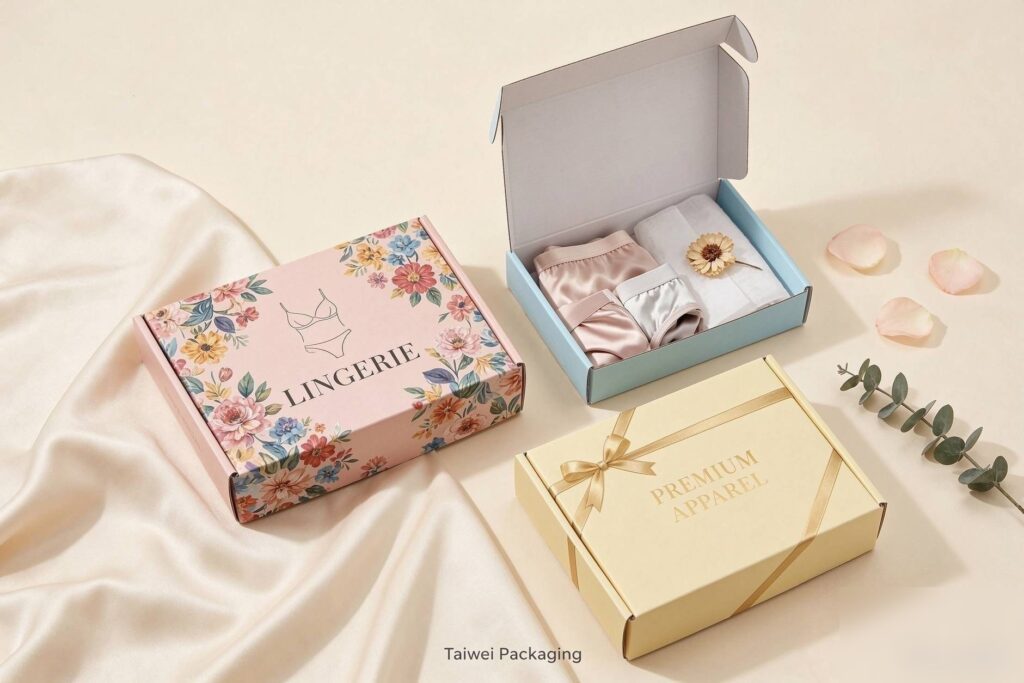
Table of contents
- Choose the first sample
- Compare E-flute and B-flute
- Compare paperboard and molded pulp inserts
- Compare unit costs and minimum order quantities
- Mailer box procurement FAQ
1.Which corrugated mailer boxes with inserts should you sample first?
Start with an E-flute mailer and a die-cut paperboard insert for a lightweight product with a regular shape. Use slots to limit sideways movement and folded tabs or a top stop to control vertical movement. Set acceptance limits for product movement, surface damage, and box deformation before testing. Apply the result to the packed configuration you tested.
Use the failure to decide what to change
Assess the outer box and the product separately when you open a test sample. The location of the damage helps you choose the next change.
| What you see | What to check | What to change |
|---|---|---|
| The box corners are intact, but the product is scuffed. | Look for a matching cut edge or contact point on the insert. | Move the contact point or reduce the clearance that allows rubbing. |
| The product stays seated, but the wall bows inward and touches it. | Check where the load reached the wall, the board grade, and the clearance. | Keep the insert and trial a different board grade or B-flute. |
| The lid presses on the product as soon as it closes. | Check the tallest product seated in the insert. | Lower the support or increase the usable internal height. |
For subscription boxes with rotating contents, test the assortment most likely to shift and the one most likely to press against the lid. Include cards, dividers, and extras in their shipping positions.Custom corrugated mailer boxes with inserts.
2.Is E-flute or B-flute better for mailer boxes with detailed printing?
With comparable liners and direct-print processes, E-flute is a practical first choice for fine text and solid colors. Its closer flute spacing supports the liner at shorter intervals. B-flute is worth testing when the wall deforms, and a preprinted liner can also be laminated onto it. Approve graphics and protection on finished samples made to the proposed specifications.Model Group flute guide · BOBST corrugated printing guide.
Check the print proof and packed sample separately
- Print proof. Use the same artwork to compare the smallest type, visible flute lines in dark solids, and whitening at folds. If the liner is printed separately, check it after lamination, die-cutting, and folding.
- Packed sample. Keep the product, insert, and usable internal dimensions comparable. Record the finished board thickness and outside dimensions. Check lid clearance and any change to the dimensions used for shipping charges.
| Buying criterion | E-flute mailer | B-flute mailer |
|---|---|---|
| Protection and typical use | First sample for a lightweight product with detailed graphics | Comparison sample when the box wall deforms |
| Print surface | Trial fine text and solid colors with direct printing | Proof the specified liner and consider lamination |
| Barrier and temperature | Review the complete box for ambient shipment | Review the board, surface treatment, and closure on the same basis |
| Recycling and certification | Check the finished materials, local collection rules, and supplier documents | Include any added liner, adhesive, or film in the review |
| Cost and MOQ | Quote the board, printing, converting, and quantity breaks | Use the same print acceptance criteria and itemize any added process |
3.When should you use a die-cut paperboard insert or a molded pulp tray?
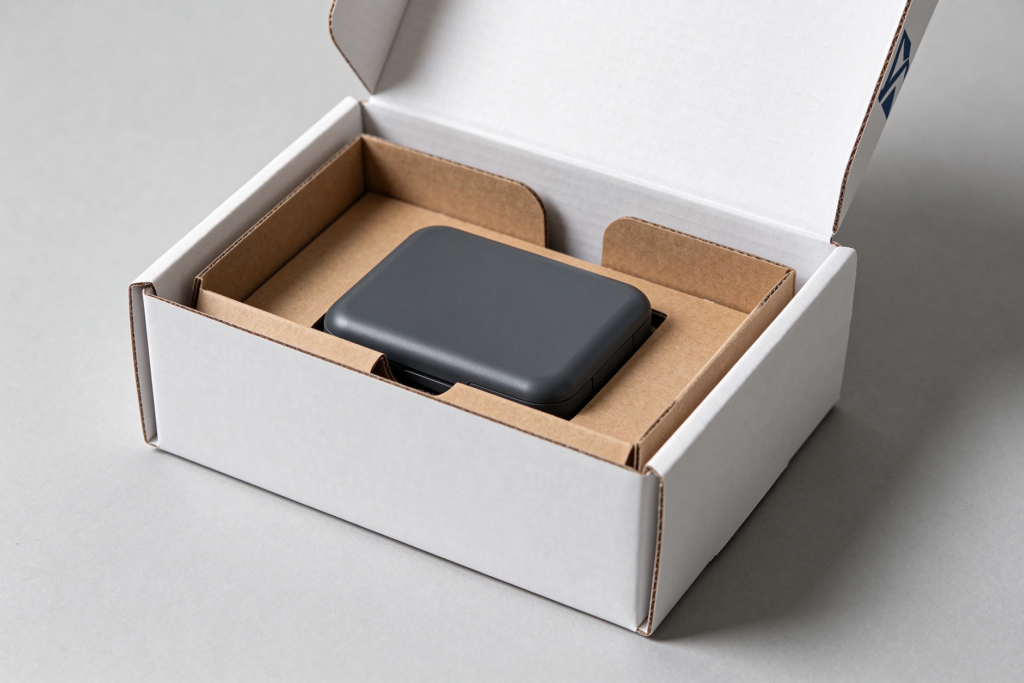
Choose die-cut paperboard when a slot or tab can grip the product clear of scuff-prone surfaces. Consider molded pulp when an irregular product rocks around a single fixing point and needs support in several places. Test the smallest and largest units expected in production. Approve the insert against movement, ease of removal, and marks on the actual product.
Test both ends of the product size range
Try sliding the smallest unit out of its slot. Fit the largest unit, close the lid, and check how easily the product comes out. If a tighter slot traps the larger unit, move the support points or trial a molded tray.
| Buying criterion | Die-cut paperboard insert | Molded pulp tray |
|---|---|---|
| Protection and typical use | Slots and folds locate regular lightweight items | Shaped surfaces support irregular products at several points |
| Print surface | Proof artwork on the visible paperboard | Test any required graphics on the formed surface |
| Barrier and temperature | Check the specified paper and coating | Check the fiber formulation and any surface treatment |
| Recycling and certification | Check coatings, adhesive, supply documents, and local acceptance | Check fiber additives, supply documents, and local acceptance |
| Cost and MOQ | Quote the cutting die, flat-packed freight, and folding labor | Quote the forming tool, unit price, nesting height, and insert MOQ |
4.How do you compare unit costs and MOQs for mailer boxes with inserts?
Request both quotes using the same usable box dimensions, print acceptance criteria, order quantities, and delivery terms. Ask for separate minimum order quantities for the box and insert. Divide first-order spend by the number of complete sets you can receive. For reorders, confirm whether tooling can be reused and whether leftover inserts can be applied to the next run.
Calculate the cost per complete set
- Itemize the charges. Ask for separate lines for boxes, inserts, samples, tooling, assembly, and freight. Confirm which charges the quoted set price already includes.
- Account for surplus components. If the insert minimum exceeds the box order, include the extra inserts in first-order spend. Record how many remain, who stores them, and how they’re applied to the reorder.
- Compare on the same basis. Divide first-order spend by deliverable sets. Include folding and assembly labor for paperboard and the freight impact of nested molded trays.
Send your product sample or dimension drawing, sensitive areas, artwork, delivery method, and target quantity. Ask for a baseline sample and one comparison. Change the flute if wall deformation is the concern, or change the insert if the product shifts.
Corrugated mailer box and insert procurement FAQ
Approve fine print on the finished box, confirm minimum quantities in the written quote, and evaluate protection with the product packed. These checks cover different parts of the buying decision. If the board, insert, or contents change, repeat the affected check. Use test results for the configuration and delivery conditions they cover.
Can B-flute reproduce fine text?
It can be sampled with a separately printed liner laminated to the board. Check the smallest text, solid colors, and corners after folding. Include lamination in the quote.
Does a low-MOQ mailer box quote include a custom insert?
Ask the supplier to list the box, insert, and complete-set minimums. Confirm tooling fees and how surplus inserts will be handled.
Do lightweight products still need a packed-product test?
Yes, when the shipping risks warrant it. Vibration can cause a lightweight item to rub or come loose. For eligible single-parcel shipments, ISTA 3A can evaluate the packed configuration. Define acceptable movement, product damage, and box condition before testing.